
Latest Event Updates
Community libraries
The town of Chapelton recently welcomed its first community library just in time for National Storytelling Week 2018.
The books, which will be located in a quiet corner of the popular Teacake Café, will act as a community library corner, or a book swap, where it is hoped residents of all ages will be able to swap, read and discuss some of their favourite books and stories. So why libraries are so important in today’s digital world?
Many people believe libraries to be a thing of the past due to the digital revolution and the rise of a gadget enamoured society. However,
 “The National Literacy Trust says that children who go to a library are twice as likely as those who don’t to read well. It is not just picking up a book. It is the social experience of reading, talking about the books, browsing, comparing what you have read with family and friends. Librarians are gate keepers in that process. They open doors to new worlds, new possibilities. They ask library visitors to evaluate the information on offer. Most importantly, they give access to narratives. Children and adults do not just need information to thrive as thinking beings, but stories. Libraries are the temple of story. They are not in decline because of some natural, historic progression, but because of the monstrous cultural vandalism of savage cost-cutting. We will pay a terrible price for the behaviour of our masters.” (Alan Gibbons)
Libraries are seen by many as a lifeline and a crucial public service, especially if you are elderly, socially isolated, poor, vulnerable, or all of the above.
So why are libraries so important and why must we protect and improve them?
- They’re accessible
The obvious advantage of having a local library is that it is local. Accessibility is crucial if you have mobility problems and/or haven’t got the money for bus fare.
- They help to bridge the digital divide
People in rural areas face significant challenges when it comes to IT access, including infrastructure problems and set-up costs. The vast majority of public libraries offer free IT access and basic IT training to the public.
- They help to combat social isolation
Libraries are social places where people can chat, read and keep in touch with the outside world. For elderly people who can’t access a static library, mobile and housebound services can fill the gap. Sometimes a friendly smile from a library worker can make all the difference to an isolated and vulnerable persons day or week.
According to C.S. Lewis “You can never get a cup of tea large enough or a book long enough to suit me”. So next time you’re in Chapelton pay a visit to the Teacake Café and sample what both have to offer.
Wheelchairs on the beach
A visit to the beach or wild areas if you are in a wheelchair is generally problematic. However Scottish Natural Heritage (SNH) and Scotland’s National Nature Reserves are providing 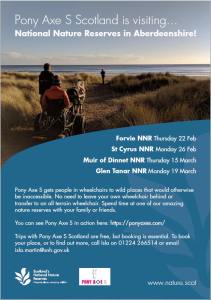 such an opportunity. Working with Pony Axe S , four, free events including one at St Cyrus Nature Reserve on 26th February 2018 have been arranged in Aberdeenshire. There is no need to transfer to all terrain or beach wheelchairs, no need to leave your wheelchair behind they take people, who use wheelchairs to all the places where wheelchairs can’t take them. The trips with Pony Axe S are free, but booking is essential. To book your place, or to find out more, call Isla on 01224 266514 or e-mail isla.martin@snh.gov.uk
Aberdeenshire Council have launched a major survey so that they can improve communities and quality of life for disabled people. Your views will help inform future planning. They will be shared with relevant agencies who can take action to improve your community. The survey has been developed by the Physical Disability Strategic Outcome Group (PDSOG). This group includes disabled people, carers and people from Aberdeenshire Council, NHS Grampian (NHSG) and voluntary organisations in Aberdeenshire. This group leads the direction for planning, developing and delivering services for physically disabled people in Aberdeenshire. They are asking disabled people what it is like to live in Aberdeenshire.
So if you have a disability or you know someone who has, complete the survey to ensure that your voice is heard. Click on the link to take part Living with a disability in Aberdeenshire
Printed copies are available by calling the Council on 03456 081206
A Cupful of Sugar
Borrowing from neighbours was once a commonplace practice, part of the network of relations we once had with those who lived within close range. 
So what’s changed?
The industrial revolution brought affordable modern technology—with it quick transportation and supermarkets. In ancient times, hunting, gathering, and foraging were communal practices. And it wasn’t long ago that many cultures, especially rural ones, still relied on weekly markets, traveling salesmen, and the growing of their own goods. But living in relative isolation also meant more contact with your neighbours because one of them probably provided your weekly dairy needs and another milled wheat for flour or grew pears you exchanged for apples.
Changes in food technology, making fresh produce less perishable, extending shelf life, has decreased the interaction we have with those who live close by to help out when we are running short. Communal cooking practises regularly seen in other countries don’t feature in our society.
It’s easy to reflect on past practises with rose tinted spectacles. Changes in our food supply has brought countless benefits. However, does the growing reliance on foodbanks indicate we should re-evaluate practises long forgotten? Reconnecting with our neighbours in times of need would not only strengthen bonds within our communities but provide welcome support during difficult times. The social distance created by modern society is a symptom of our increasingly busy lives and the sprawling communities we now live in. However, it is only a short walk next door for that cupful of sugar, but the benefits to our communities can stretch much further than that.
‘An Apple a day’
Established as a community volunteer group in late 2013, Brighter Bervie does what it says on the tin – the group brightens up the environment and community spirit in Inverbervie and the surrounding district. The focus of the groups’ activity is around a gardening project, transforming neglected spaces and street corners into attractive locations for the benefit of visitors and residents.
In the autumn of 2017 volunteers from Brighter Bervie, along with Fiona and Kevin from our partners Scottish Association for Mental Health (SAMH), visited Bervie Primary School.
At the school’s morning assembly, in which all the pupils take such an active and enthusiastic part, Fiona engaged with them to share information about the work that SAMH does to help people cope with mental illness. Gardening is one of the therapeutic activities which SAMH promotes.
 In the afternoon the Outdoor Learning Group came out to the school garden to plant 5 apple trees donated by SAMH. Now a patient 2-year wait is required until they can pick and eat the fruit.
This work is part of the Edibles Trail project which Brighter Bervie is implementing around our Royal Burgh. Brighter Bervie’s volunteers are continuing to plant more fruit, vegetables, herbs and edible flowers along the trail for folk to pick, (cook) and eat free of charge. The intention of the scheme is to connect people with natural healthy food sources as well as encouraging them to walk about and take a deeper interest in this wonderful community that we sometimes take for granted.
Bervie’s Edibles Trail is being developed along with trails in Portlethen and St Cyrus as the first three in South Aberdeenshire under the auspices of Aberdeenshire Voluntary Action (AVA).
The impact of Burn’s Night
Image Posted on
Local events are a great way to bring communities closer together. Whether you want to raise funds for a worthy cause, bring about positive change in your area, celebrate something special or simply get to know your neighbours, a community event can help rally the masses.
A topical one today is the celebration of Robert Burns, born 25th January 1759, who is widely regarded as the national poet of Scotland and is celebrated worldwide. A Burn’s  Night can be formal or informal, but most importantly it is a social event and a way for families, friends and communities to come together to enjoy some traditional fayre in the form of haggis (vegetarian options available), tatties & neeps and to celebrate the ‘bard’. However the most important ingredient is to have fun.
So in homes, village halls, hotels & restaurants all over Scotland people and communities will be coming together and enjoying ‘Great chieftain o’ the puddin-race’.
Are we just consumers?
Living in a consumer society we are well versed in paying money and getting goods and services in return, but does this make us less appreciative of what we receive? Do we notice the skills involved in making something, the time & thought that has gone into its creation or listen for all the instruments that make up a tune. If we had to make something from scratch would it make a difference to how we viewed the things around us?
Have a think about all the things that you consume and love. Is it books, music, food, fashion, growing your own vegetables? Maybe you enjoy home cooked food, watching and listening to someone playing the guitar or singing. Or perhaps you admire someone who knows how to code, or builds shelves or fixes cars, but you’ve never thought you’d be able to do something like that.
 Consuming is easy. Getting inspired is easy. Following instructions is easy. But when you go from a consumer to a creator, you may start to think about things you never thought about before. Instead of observing and consuming, pick something and try to become the creator yourself. As well as the satisfaction and pride from making something research has shown that creating or tending things by hand makes us happy and enhances mental health. So as the New Year starts why not plan to make something rather than buy it!
“Are Ewe Okay”
In 2014 figures released by the Office for National Statistics showed that people in the UK are among the most lonely and isolated in Europe. The ONS data compared the UK with the rest of Europe. The UK came second from bottom for not feeling close to people in their local area. Germany came bottom and Cyprus came top. Loneliness and isolation can have a major impact on people’s wellbeing and mental health.
In the latest ONS Survey “Measuring national well-being: Life in the UK, Apr 2017” it shows that whilst many aspects of our lives have improved, areas that have deteriorated over a 3-year basis included the mental well-being of the population.
 Isolation & loneliness affects many in our countryside and this was recognised by young people working within the agricultural industry. The Scottish Association of Young Farmers Clubs (SAYFC) began the mental health awareness campaign “Are EWE Okay” in May 2016 during mental health awareness week. They recognised that there was a stigma associated with mental health issues, people working in the agriculture & rural industries are often working on their own so are facing isolation and through the nature of the work people often find it difficult to access services or support. Through the campaign they aimed to challenge the attitudes towards mental wellbeing for the industry’s next generation. In October 2017 their campaign was named as a ‘Farming Hero’ during the British Farming Awards.
Social media is often criticised for a variety of reasons, however in this instance it is being used in a positive way by a recognised body to reach its members – young people, who may otherwise have no one to turn to. The principles of ‘Are Ewe OK’ can so easily be transferred to anyone so perhaps we could all ask ‘Are you ok’?
Community Cohesion – Do ants hold the secret to human success?
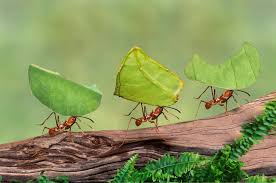 Solomon thought so, he says to ‘go to the ant’ and ‘consider the ant’ and refers to them as little upon the earth but exceeding wise. He suggests that taking a leaf from their book will preserve us from poverty and give us wisdom. Given Solomon is the richest man the world has ever known (today he would be worth 100 times more than John D Rockefeller), some ant facts are worth knowing.
So, how do ant communities do it?
1. Strong leadership
Ant communities are headed by a queen or queens, whose function in life is to lay thousands of eggs that will ensure the survival of the colony. Workers (the ants typically seen by humans) are wingless females that never reproduce, but instead, forage for food, care for the queen’s offspring, work on the nest, protect the community, and perform many other duties. When the queen of the colony dies, the colony can only survive a few months. Queens are rarely replaced and the workers are not able to reproduce. The lesson;
Without strong and clear leadership – failure is imminent!
2. Communicate & cooperate
Ants are social insects which form colonies that range in size from a few dozen predatory individuals living in small natural cavities to highly organised colonies which may occupy large territories and consist of millions of individuals. Ants communicate and cooperate by using chemicals (pheromones) that can alert others to danger or lead them to a promising food source. The lesson;
Nothing can succeed without clear communication and cooperation.
Kindness within a Community: Combating loneliness and building stronger communities
 Carnegie Trust UK have published their second report looking at loneliness and social isolation and the impact of kinder communities. The report finds kindness is a necessary ingredient of successful communities. However there are major factors that get in the way of engaging and encouraging kindness both in individuals and organisations. Read the report here
Have a healthy Christmas
 Christmas is a time of giving and receiving, spending time with friends and family and maybe overindulging just a little bit?
Here are our top tips to ensure you don’t start 2018 with that sinking feeling of too much Christmas pudding being the final straw;
- Don’t sit down all day – go for a walk, kick a football about, ride a new bike. Not only will this aid digestion, but help you sleep better too.
- Go easy on the booze
- Don’t give yourself a Christmas stuffing! Recent research suggests that we consume around 3,000 calories in our Christmas dinner – more than the entire recommended daily intake for a grown man!
- Keep colds at bay
- Don’t stress – ’tis the season to be jolly remember
- Eat fruit – even the clementine tucked in the bottom of your stocking will boost vitamin C warding coughs and colds.
- Do something for others – do you have an elderly neighbour who would love to share some festive spirit?
- Engage your brain – play games, do a crossword, not only does this keep your mind active but can be fun for the whole family

Don’t Try This At Home.
It’s never too late to rectify those ill-fated New Year’s Eve resolutions in which you swore to lead a healthier life. But if traditional spas leave you cold and meditation bores you, don’t worry, there are plenty of other options out there.
- Prison pampering, Thailand
While a visit to a Thai correctional institution may scream holiday hell rather than whisper wellness, in Chiang Mai a trip to prison is an unorthodox experience.
Inmates at the women’s correctional institution are given holistic training that will aid job prospects once released. They pamper visitors using the skill learned. It not only soothes aches and pains, but any tips earned are kept for prisoners on their release.
- Wine Spa Japan
At the end of a hard week, for many people one of the best ways to relax and unwind is with a glass or two of red wine.
But why not go one step further than drinking the stuff, and book a trip to the Yunesson Spa Resort in Japan?
It’s a self-described ‘spa theme park’ where you can legitimately bathe in hot tubs filled with Merlot or Bordeaux.
- Laughter Yoga
Invented by Indian doctor Madan Kataria in the mid-Nineties, laughter yoga now has thousands of devotees. Many sessions, are free for anybody to join, providing newcomers don’t mind an early start. Propelled by the philosophy that laughter gives humans huge spiritual and medical benefits, its main objective couldn’t be simpler – to set you’re giggling, howling, chortling and smirking instincts free.
- Buried Alive; a shamanic death & rebirth
With hopes of experiencing a closer connection with Mother Nature, pilgrims journey to the northwest coast of the US to take part in a shamen led burial ceremony.
Free spirited individuals are taken into the wilderness and covered fully with earth. After re-emerging individuals are said to feel a deeper connection and knowledge of spirit and creation.
http://thepracticalshaman.com/buried_alive/
- Cryotherapy, Slovakia
Nothing shouts health kick like freezing bits off in temperatures of -120c. Sportsmen and women have been using cryotheraphy to aid recovery for decades but now the public can don gloves, a face mask and step into a giant fridge.
Benefits are said to include the natural productions of enzymes and hormones as endorphins, adrenaline and testosterone are released. It’s the coolest wellness trend in town.
Mexico City’s bike revolution
It’s an eerily calm Sunday morning on the city’s Avenida Reforma, an avenue which is grid-locked on weekdays by tens of thousands of cars sitting bumper-to-bumper.
The Reforma’s closure to car traffic on Sundays in 2007 kickstarted the capital’s attempts to make life easier for cyclists. In 2010 a 17km-long bike lane through the city opened.
The car still reigns supreme in this metropolis of 22 million people, with more than four million vehicles clogging the roads every day.
 Perhaps the biggest factor has been the launch of the so-called Ecobicis (Eco-bikes) in 2010. Following on from similar schemes operating in London, Paris and Barcelona, Mexico City launched a public bike rentals at 90 different sites. Since then, some 30,000 people have joined and there is a waiting list for new members. The Ecobici system is expected to expand to 75,000 users by the end of 2012, with 4,000 more bicycles made available at new sites.
The scheme is not without it’s critics with some of Mexico City’s drivers spending up to four hours a day on their journeys to work, with three separate rush-hours. Some say cyclists have only made matters worse.
One local radio host Angel Verdugo angered bike users when he called on car drivers to run over the cyclists. He said championing the new breed of cyclists was a form of racism. “They want to be like Europeans,” he says. “They believe they are living in Paris and riding along the Champs-Elysees.”
He subsequently made a public apology.
There’s no doubt that Mexico City is for the most part still a car-orientated city but it is also clear that cycling is in the ascendancy. More cycle ways are planned, and public opinion supporting active travel is growing. A car free city is, however, a long way off.
 K&M Communities