
healthy lifestyles
Mental Muscle
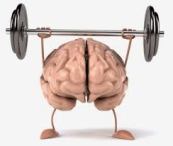
Mentally strong kids turn into resilient adults who are equipped to tackle whatever life throws their way. Challenges, hardship, and setbacks are inevitable. Teaching kids to build mental muscle can make them resilient. It’s also the key to helping them reach their greatest potential in life.
Here’s three things you can do to help equip your kids for the future.
- Teach your kids to think realistically
Children need to develop healthy self-talk. Simply thinking positive isn’t the solution, this doesn’t prepare children for real-life challenges. A child who can reframe negative thinking by coming up with a solution is more resilient. For example, instead of saying I’m going to fail that physics test, a resilient child will tell herself I can pass this test by
Teach children to challenge their negative thoughts and prove themselves wrong.studying hard and asking for help.
- Teach your kids to manage their emotions
A national university students found that more than 60 percent of young people don’t feel emotionally prepared for the realities of life. They lack the skills to deal with uncomfortable emotions, like loneliness, sadness, and anxiety.
It’s important to educate kids about their emotions and how those emotions influence them. A child who can say, “I’m feeling anxious and that anxiety makes me want to avoid scary things,” will be better equipped to face his fears. He’ll also have a better understanding of how to cope with his emotions and he’ll have more confidence in his ability to handle discomfort. Validate your children’s emotions and teach them they have choices in how they deal with their feelings.
- Teach your kids to take positive action
Thinking realistically and feeling good are only half the battle. Kids also need to take positive action. Unfortunately, many parents are quick to rescue kids from their struggles. Or they micromanage their daily activities. And consequently, kids don’t learn to make healthy choices on their own.
Proactively teach your kids problem-solving skills. Show them they have the power to make a difference in their lives and in other people’s lives.
Flex your mental muscles, it’s worth it.
Put Your Best Foot Forward
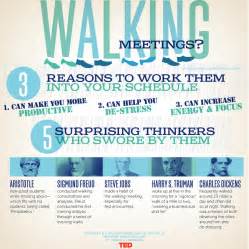
Thinking, talking, and walking are inextricably linked through history. It is only a recent idea that we meet around tables, seated in chairs. We want to help you rediscover and share the value of walking meetings.
Aristotle was said to walk as he taught, founding what we now refer to as Ancient Greece’s Peripatetic School of Philosophy. This name was derived from the colonnade or walkway in the Lyceum in which he taught. The Sophists, philosophers predating Socrates, were wanderers. They travelled place to place on foot delivering talks.
 Despite the onslaught of “mobile” technology, people are spending more time sitting at their desk than ever before. The average worker sits about 9.5 hours a day – which is 2 hours more per day than they sleep.
What keeps us tethered to our desks? Our insatiable thirst for increased productivity and efficiency. Ironically, one of the things that makes us most effective is leaving our desks.
It’s well-known that Steve Jobs insisted on walking meetings, and Mark Zuckerberg favors them as well.
Here are 7 reasons you want to consider incorporating moving meetings into your culture:
- Employee Health.
Walking meetings allow employees to integrate physical activity throughout their workday, which yields improved health, lower health care costs, and a lower number of sick days. - Higher Employee Energy
Movement yields circulation; circulation yields energy. Rather than reach for a biscuit to get a boost of energy, take a walk outside. - Inspiration.
Nature and changes of scenery trigger new neuro-pathways in our brains which yield new ideas, and new solutions to problems. - A Flatter Organization.
- Technology executive Nilofer Merchant shares in her 3-minute TED Talk that when executives and employees walk side-by-side, the hierarchical boundaries are virtually eliminated.
- Increased Collaboration.
- Walking meetings aren’t just for a few people. Larger groups can benefit as well. Unlike traditional meetings in a conference room, where attendees take a seat and often don’t move until the meeting is over, mobile meetings give attendees the option of moving freely from one conversation to another.
- Stronger Personal Connections.
Walking meetings take the corporate feeling out of meetings. Employees can accomplish the same goals set for a traditional meeting, but they can relate on a much more personal level. - Minimized Differences.
Walking meetings bring everyone together. As companies continue to employee 5 different generations of workers, and as diversity increases in the workforce, walking meetings break down both conscious and unconscious biases and barriers.So next time you’re scheduling a meeting, why not give a walking meeting a go?
U3A (The University of the Third Age)
…is a UK-wide movement which brings together people in their ‘third age’ to develop their interests and continue their learning in a friendly and informal environment.
If you’re wondering what we mean by the third age – it is a time after you have finished working full-time or raising your family and have time to pursue your interests or just try something new.
As you get older, keeping your mind active and healthy can become a big challenge, but it’s well documented that keeping your mind active has a direct impact on physical health too.U3A has a ‘university’ of members who draw upon their knowledge and experience to teach and learn from each other but there are no qualifications to pass – it is just for pleasure. Learning is its own reward.
It’s all voluntary; a typical U3A will be home to many activity groups covering hundreds of different subjects – from art to zoology and everything in between.
Formed over 30 years ago, there are now over 1,000 U3As across the UK, with thousands of interest groups between them and more than 400,000 members nationally – plus it’s growing every day.
Want to join, click here https://www.u3a.org.uk/find
What does “wellbeing” mean to you?
Welcome to the second of Kincardine and Mearns local community plan priorities.
Communities, both place-based and people sharing a common identity or affinity, have a vital contribution to make to health and wellbeing. Community life, social connections, supportive relationships and having a voice in local decisions are all factors that underpin good health, however, inequalities persist and too many people experience the effects of social exclusion or lack social support. Participatory approaches directly address the marginalisation and powerlessness caused by entrenched health inequalities.

The assets within communities, such as the skills and knowledge, social networks, local groups and community organisations, are building blocks for good health. Many people in Kincardine & Mearns already contribute to community life through volunteering, community leadership and activism. Community empowerment occurs when people work together to shape the decisions that influence their lives and health and begin to create a more equitable society. This is not about a DIY approach to health; there are important roles for NHS, local government and their partners in creating safe and supportive places, fostering resilience and enabling individuals and communities to take more control of their health and lives.
Over the next few weeks we will share with you some stories about wellbeing and what it means to a variety of people. Look out for our first blog next week.We hope you enjoy
Forget the gym…..
Middle-aged people are being urged to walk faster to help stay healthy, amid concern high levels of inactivity may be harming their health.
They are urging those between the ages of 40 and 60 to start doing regular brisk walks.
 Just 10 minutes a day could have a major impact, reducing the risk of early death by 15%, they say.
But estimates show four out of every 10 40- to 60-year-olds do not even manage a brisk 10-minute walk each month.
An American study found that people who walked for at least four hours a week gained less weight (an average 9 lb less) than couch potatoes as they got older.
Last year, researchers at the University of Colorado found that regular walking helped to prevent peripheral artery disease (which impairs blood flow in the legs and causes leg pain in one-fifth of elderly people).
Walking can even prevent colds. Researchers at the University of Massachusetts medical school found that people who walked every day had 25 per cent fewer colds than those who were sedentary.
Because walking is a weight-bearing exercise, it can also help prevent the bone
 disease osteoporosis.
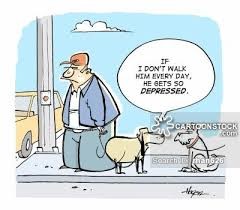
Best of all, walking makes you feel good about yourself. “For people suffering from depression, walking three to four times a week for 30 minutes has been shown to enhance their mood
So next time you have 20 minutes to spare, put on your shoes and start your journey to better health.
Be Active
If you were told by a Dr – take this magic pill daily and you will reduce numerous health risks, be fit and healthy……would you take it? Unfortunately the wonder pill doesn’t exist, however in its place we are going to prescribe everyone regular physical activity/exercise and put you on the path to the same results. A little motivation can go a long way.
Walking: the most accessible and easiest way for most to incorporate exercise into our lifestyles. It’s free, gentle &low-impact that requires no special training or equipment. Almost everyone can do it, anywhere and at any time. You could join a health walk, become a rambler or just walk to the shops. Check out the Aberdeenshire Council Ranger Service to find out about the rich natural heritage surrounding us.
If walking isn’t your thing, how about cycling? You could go for the standard cycle or try out an electric bike. Electric bikes (e-bikes) work much the same as ordinary bicycles except they have an electric motor which works when you pedal to give a bit of a boost, making going uphill a lot easier! You don’t need a special license to ride one (as long as you are over the age of 14) and the bikes can be used on cycle paths the same as ordinary bicycles.
Talking of cycle paths, Aberdeenshire Council transport strategy team have just finished new local ‘Walking & Cycling maps’ for several Aberdeenshire towns which are to be launched soon. We are also hearing whispers of ‘Treasure Trails’ which sounds interesting, and as far as we are concerned – anything that encourages us to get out and about is a winner in our eyes. Want to know more? Visit http://getabout.org.uk/ for more information.
Tell us what would make you more active in your community. Is there a path near you which could be a great walking route, perhaps you would like to be able to commute to work by bike? We’d love to hear from you at kandmcommunities@gmail.com
Scottish Association for Mental Health (SAMH) World Café.
SAMH are holding an event in Stonehaven on Wednesday 26 July from 1100 – 1400. The event is aimed  at professionals supporting clients with mental health needs, and clients, and is relevant to adult services only (16 – 65 years). Participants should be willing to take part in discussions and share their lived experiences of mental health services. If you would like to attend, please contact enquiries@mylifedynamic.org.uk and let them know if you will be taking along any clients on the day.
The Chapelton Bike Ride, Sunday, September 3rd 2017
The launch of new 5K charity walk aims to encourage non-cyclists to get involved with local bike ride – The Chapelton Bike Ride, Sunday, September 3rd 2017

The Chapelton Bike Ride will return for a second year on Sunday, September 3, with the addition of the new Chapelton 5K Walk sponsored by Liberty Retirement Living, which will coincide with the event’s 42-mile and 12-mile bike rides. Held in aid of North East Sensory Services (NESS), the event was formerly the Great Stonehaven Bike Ride, before it moved to the village of Chapelton, near Newtonhill. Last year, over 250 cyclists took part in the first ever Chapelton Bike Ride, raising over £6,500 for NESS. Registration costs £15 per person for the 42-mile route, £5 per person for the 12-mile route, or £15 for a team of four for the 12-mile cycle. The 5K walk is free to enter, but all participants must register via the website. Register for the Chapelton Bike Ride at www.chapeltonbikeride.co.uk.
Stonehaven Young Peoples Health and Wellbeing Event
4.30 – 7pm Tuesday, 5th September 2017, Mackie Academy
This free community event is to promote and inform adults about key aspects of our young people’s health and wellbeing. With partners across education and health sessions are being offered on:
- Social Media
- Drugs and Alcohol
- Fast and easy cooking for the family
- Young People and Sleep
- Mindfulness
Conversation Cafe – If you can only spare a short time come in and visit our information stalls, chat with the teams and friends over a cup of tea and healthy nibbles.
You can book onto these sessions by phoning 01569 762071 or online at:
http://bit.ly/HWBStonehaven from Monday, 21st August to Sunday, 3rd September 2017
OUR CHILDREN AND YOUNG PEOPLE: SUPPORTING HEALTH, WELLBEING AND SAFETY
This free community event is to promote and inform adults about key aspects of our young people’s health and wellbeing. With partners across education and health sessions are being offered on:
Social Media
Drugs and Alcohol
Fast and easy cooking for the family
Young People and Sleep
Mindfulness
You can book onto these sessions by phoning 01569 762071 or online at:
http://bit.ly/HWBStonehaven
from Monday, 21st August to
Sunday, 3rd September 2017.
CONVERSATION CAFE
If you can only spare a short time come in and visit our information stalls, chat with the teams and friends over a cup of tea and healthy nibbles.
Get a general access ticket at http://bit.ly/HWBStonehaven
MACKIE ACADEMY
TUESDAY, 5TH SEPTEMBER 2017
16.30 – 19.00
Paths for All’s Big Fit Walk campaign
 The Big Fit Walk is now in its 14th year. Its aim is simple. We want to inspire communities across Scotland to come together for a walk to celebrate the benefits of being active. It’s about having fun and staying healthy, anyone can host or attend a Big Fit Walk during the month of June! The Big Fit Walk is a fun and social way to show people the joy of a short walk. Whether you are looking to showcase an area in your community, get your workplace or school more active, or recruit new walkers to your Health Walk, the Big Fit Walk is a simple and easy way to put short local walks on the map in Scotland. Paths For All provide Health Walk groups, community groups, workplaces, schools and others with free resources to organise their own 30 minute local led walk during June. From posters and invites to get people along to your walk to a guide on running a successful walk, our pack has all the resources you will need to make your Big Fit Walk a success! To order your Big Fit Walk resource pack or download resources please visit: http://www.pathsforall.org.uk/bigfitwalk
Under Pressure – Preventing Abuse & Exploitation in Teen Relationships
Dates: Friday – 9th June or Wednesday – 1st November 2017
Time: 10.00am to 4.00pm
Venue: The Citadel
A Train the Trainer Programme from Zero Tolerance in association with YouthLink Scotland
Under Pressure is a free train the trainer programme aiming to increase the skills and capacity of youth work staff to prevent abuse and exploitation in teen relationships. This free training has been developed in partnership between Zero Tolerance and YouthLink Scotland, and will be delivered by Jackie Williams, NHS Sexual Health Trainer and Lynn Buchan, Senior Community Learning Development Worker.
We aim to deliver the Under Pressure training with staff working with young people, and ultimately work to prevent abuse and exploitation.
We welcome bookings from those who –
- Have experience of working with young people.
- Have a commitment to ending gender inequality and violence against women.
Trainers will receive:
- Specialist training on issues to do with abuse and exploitation in young people’s relationships from a lead organisation in violence against women.
- Under Pressure training resources for use with members of staff and young people to help prevent sexual exploitation.
- Under Pressure Certification.
This training is an excellent opportunity to roll out a high quality course for your staff team and learning community, obtain a great set of resources for tackling abuse and exploitation in young people’s relationships in informal education, and make a real difference in the lives of the young people you work with.
To apply please book via: nhsg.publichealthlearning@nhs.net
 K&M Communities