
Community Health
Kindness within a Community: Combating loneliness and building stronger communities
 Carnegie Trust UK have published their second report looking at loneliness and social isolation and the impact of kinder communities. The report finds kindness is a necessary ingredient of successful communities. However there are major factors that get in the way of engaging and encouraging kindness both in individuals and organisations. Read the report here
Have a healthy Christmas
 Christmas is a time of giving and receiving, spending time with friends and family and maybe overindulging just a little bit?
Here are our top tips to ensure you don’t start 2018 with that sinking feeling of too much Christmas pudding being the final straw;
- Don’t sit down all day – go for a walk, kick a football about, ride a new bike. Not only will this aid digestion, but help you sleep better too.
- Go easy on the booze
- Don’t give yourself a Christmas stuffing! Recent research suggests that we consume around 3,000 calories in our Christmas dinner – more than the entire recommended daily intake for a grown man!
- Keep colds at bay
- Don’t stress – ’tis the season to be jolly remember
- Eat fruit – even the clementine tucked in the bottom of your stocking will boost vitamin C warding coughs and colds.
- Do something for others – do you have an elderly neighbour who would love to share some festive spirit?
- Engage your brain – play games, do a crossword, not only does this keep your mind active but can be fun for the whole family

Linking Generations
 Connections between generations are proven to enrich the lives of both young and seniors in long-lasting and meaningful ways.
When young people find ways to engage and develop relationships with the elderly, these experiences can build self-esteem, develop leadership skills, and encourage a lifelong commitment to volunteering.
For seniors, intergenerational connections provide the opportunity to transfer knowledge and wisdom, acknowledge self-worth, and feel they are contributing members of society.
In today’s world, many young people are experiencing less interaction with seniors because of homogenous neighborhoods, dispersed extended families, and increasing segregation of seniors living in care facilities or in isolation
Some of the benefits of intergenerational work include:
- Creation of age friendly communities.
- All generations have a lot to both teach and learn from each other and contribute to lifelong learning.
- Tackles issues around stereotyping and ageism.
- Increases understanding and respect between older people and younger people.
- Chance to make new friends and combats social isolation.
Put Your Best Foot Forward
Thinking, talking, and walking are inextricably linked through history. It is only a recent idea that we meet around tables, seated in chairs. We want to help you rediscover and share the value of walking meetings.
Aristotle was said to walk as he taught, founding what we now refer to as Ancient Greece’s Peripatetic School of Philosophy. This name was derived from the colonnade or walkway in the Lyceum in which he taught. The Sophists, philosophers predating Socrates, were wanderers. They travelled place to place on foot delivering talks.
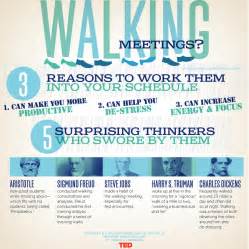 Despite the onslaught of “mobile” technology, people are spending more time sitting at their desk than ever before. The average worker sits about 9.5 hours a day – which is 2 hours more per day than they sleep.
What keeps us tethered to our desks? Our insatiable thirst for increased productivity and efficiency. Ironically, one of the things that makes us most effective is leaving our desks.
It’s well-known that Steve Jobs insisted on walking meetings, and Mark Zuckerberg favors them as well.
Here are 7 reasons you want to consider incorporating moving meetings into your culture:
- Employee Health.
Walking meetings allow employees to integrate physical activity throughout their workday, which yields improved health, lower health care costs, and a lower number of sick days. - Higher Employee Energy
Movement yields circulation; circulation yields energy. Rather than reach for a biscuit to get a boost of energy, take a walk outside. - Inspiration.
Nature and changes of scenery trigger new neuro-pathways in our brains which yield new ideas, and new solutions to problems. - A Flatter Organization.
- Technology executive Nilofer Merchant shares in her 3-minute TED Talk that when executives and employees walk side-by-side, the hierarchical boundaries are virtually eliminated.
- Increased Collaboration.
- Walking meetings aren’t just for a few people. Larger groups can benefit as well. Unlike traditional meetings in a conference room, where attendees take a seat and often don’t move until the meeting is over, mobile meetings give attendees the option of moving freely from one conversation to another.
- Stronger Personal Connections.
Walking meetings take the corporate feeling out of meetings. Employees can accomplish the same goals set for a traditional meeting, but they can relate on a much more personal level. - Minimized Differences.
Walking meetings bring everyone together. As companies continue to employee 5 different generations of workers, and as diversity increases in the workforce, walking meetings break down both conscious and unconscious biases and barriers.So next time you’re scheduling a meeting, why not give a walking meeting a go?
U3A (The University of the Third Age)
…is a UK-wide movement which brings together people in their ‘third age’ to develop their interests and continue their learning in a friendly and informal environment.
If you’re wondering what we mean by the third age – it is a time after you have finished working full-time or raising your family and have time to pursue your interests or just try something new.
As you get older, keeping your mind active and healthy can become a big challenge, but it’s well documented that keeping your mind active has a direct impact on physical health too.U3A has a ‘university’ of members who draw upon their knowledge and experience to teach and learn from each other but there are no qualifications to pass – it is just for pleasure. Learning is its own reward.
It’s all voluntary; a typical U3A will be home to many activity groups covering hundreds of different subjects – from art to zoology and everything in between.
Formed over 30 years ago, there are now over 1,000 U3As across the UK, with thousands of interest groups between them and more than 400,000 members nationally – plus it’s growing every day.
Want to join, click here https://www.u3a.org.uk/find
“We never had so much need of storytelling and its healing powers.” George Mackay Brown
Storytelling activities provide opportunities for the socially and educationally excluded to take part in cultural experiences that provide a platform for a sense of community, inclusion, and understanding. We all have a story to tell, and storytelling can provide a valuable means of self-expression and communication, as well as building confidence and self-esteem and combating feelings of loneliness and isolation.
Handmade Tales
Handmade Tales was an eight-week project that offered carers and those experiencing mental health problems some ‘time out’ in the form of storytelling sessions. Facilitated by storyteller Claire Hewitt, these Handmade Tales sessions gave the carers the opportunity to socialise with people going through similar experiences, have some much needed ‘me time’ and find a voice to tell their own stories. This helped them to reconnect and rebuild stronger relationships with family and friends – especially with the person the care for.
 Claire led participants through a programme of storytelling and arts and craft activities all linked to the theme of spring. Whilst the hands were busy felting, stitching, thumping clay or making bread, stories were shared. Storytelling and the accompanying handwork gave participants the skills to express who they are, help them reconnect with forgotten dreams and celebrate life and the growth of something new. These sessions gave the carers the opportunity just to have a break away from their caring role, and act as a reminder that they too are important and they need to look after themselves.
This project was in collaboration with Support in Mind Scotland and the Scottish Storytelling Centre and supported by the Scottish Government ‘Short Breaks Fund.
A Nation of Cyclists
The famous Dutch obsession with bicycles is clearly paying off – a recent study has shown.
While there have been a plethora of studies demonstrating the health benefits of cycling as a means to reduce the risk of sedentary lifestyle diseases and all-cause mortality, the study “Dutch Cycling: Quantifying the Health and Related Economic Benefits” – is the first to actually quantify the health benefits and related economic benefits at a population level in the Netherlands. Currently, about 27% of all trips in the Netherlands are made by bicycle and the weekly time spent cycling is about 74 minutes per week for Dutch adults of 20 to 90 years of age. Even more noteworthy and remarkable, over half of the total life expectancy increase calculated in this study is being achieved by cycling among adults aged 65 and older.
The study clearly shows that Dutch investments in bicycle-promoting policies, such as improved bicycle infrastructure and facilities, are likely to yield a high cost-benefit ratio in the long term. Health benefits translate into economic benefits of over 5% of Dutch GDP. To calculate the economic health benefits of cycling, HEAT (Health Economic Assessment Tool) uses a standard value of a statistical life (VSL) to monetize the number of deaths per year prevented by cycling. With a Dutch VSL of € 2.8 million per prevented death, investment in cycling is an extremely wise economic investment. The €0.5 billion per year spent by the Dutch government on road and parking infrastructure for cycling is estimated to yield total economic health benefits of € 19 billion per year!
 Investments in high quality cycling policies and infrastructure produce great benefit over the long term. Cycling for transport delivers wealth and health, quality of life, for people and for cities.
North Kincardine Treasure Map
Newtonhill, Muchalls & Cammachmore Community Council have been busy developing the North Kincardine Treasure map. 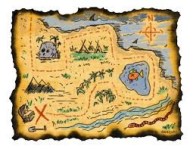
Its aim to encourage people to explore North Kincardineshire supports the work we have been doing to enhance and increase activity in the local area. A copy of the map has been delivered to all dwellings in Council Ward 17, highlighting five key trails with points of interest along the way. An interactive website provides additional information and routes and will develop into a valuable archive of the area.
The ‘Treasure Map’ project was linked to an Integrated Travel Town Project and a Community Sports Hub (CSH) ‘healthy weight project’. It encourages local residents to get out and about and tells them more about their local area. This is community and Council working together to create something special for the whole community!”
Want to know more? Visit http://www.discovernorthkincardine.org.uk/index.html
Forget the gym…..
Middle-aged people are being urged to walk faster to help stay healthy, amid concern high levels of inactivity may be harming their health.
They are urging those between the ages of 40 and 60 to start doing regular brisk walks.
 Just 10 minutes a day could have a major impact, reducing the risk of early death by 15%, they say.
But estimates show four out of every 10 40- to 60-year-olds do not even manage a brisk 10-minute walk each month.
An American study found that people who walked for at least four hours a week gained less weight (an average 9 lb less) than couch potatoes as they got older.
Last year, researchers at the University of Colorado found that regular walking helped to prevent peripheral artery disease (which impairs blood flow in the legs and causes leg pain in one-fifth of elderly people).
Walking can even prevent colds. Researchers at the University of Massachusetts medical school found that people who walked every day had 25 per cent fewer colds than those who were sedentary.
Because walking is a weight-bearing exercise, it can also help prevent the bone
 disease osteoporosis.
Best of all, walking makes you feel good about yourself. “For people suffering from depression, walking three to four times a week for 30 minutes has been shown to enhance their mood
So next time you have 20 minutes to spare, put on your shoes and start your journey to better health.
Be Active
If you were told by a Dr – take this magic pill daily and you will reduce numerous health risks, be fit and healthy……would you take it? Unfortunately the wonder pill doesn’t exist, however in its place we are going to prescribe everyone regular physical activity/exercise and put you on the path to the same results. A little motivation can go a long way.
Walking: the most accessible and easiest way for most to incorporate exercise into our lifestyles. It’s free, gentle &low-impact that requires no special training or equipment. Almost everyone can do it, anywhere and at any time. You could join a health walk, become a rambler or just walk to the shops. Check out the Aberdeenshire Council Ranger Service to find out about the rich natural heritage surrounding us.
If walking isn’t your thing, how about cycling? You could go for the standard cycle or try out an electric bike. Electric bikes (e-bikes) work much the same as ordinary bicycles except they have an electric motor which works when you pedal to give a bit of a boost, making going uphill a lot easier! You don’t need a special license to ride one (as long as you are over the age of 14) and the bikes can be used on cycle paths the same as ordinary bicycles.
Talking of cycle paths, Aberdeenshire Council transport strategy team have just finished new local ‘Walking & Cycling maps’ for several Aberdeenshire towns which are to be launched soon. We are also hearing whispers of ‘Treasure Trails’ which sounds interesting, and as far as we are concerned – anything that encourages us to get out and about is a winner in our eyes. Want to know more? Visit http://getabout.org.uk/ for more information.
Tell us what would make you more active in your community. Is there a path near you which could be a great walking route, perhaps you would like to be able to commute to work by bike? We’d love to hear from you at kandmcommunities@gmail.com
The Chapelton Bike Ride, Sunday, September 3rd 2017
The launch of new 5K charity walk aims to encourage non-cyclists to get involved with local bike ride – The Chapelton Bike Ride, Sunday, September 3rd 2017

The Chapelton Bike Ride will return for a second year on Sunday, September 3, with the addition of the new Chapelton 5K Walk sponsored by Liberty Retirement Living, which will coincide with the event’s 42-mile and 12-mile bike rides. Held in aid of North East Sensory Services (NESS), the event was formerly the Great Stonehaven Bike Ride, before it moved to the village of Chapelton, near Newtonhill. Last year, over 250 cyclists took part in the first ever Chapelton Bike Ride, raising over £6,500 for NESS. Registration costs £15 per person for the 42-mile route, £5 per person for the 12-mile route, or £15 for a team of four for the 12-mile cycle. The 5K walk is free to enter, but all participants must register via the website. Register for the Chapelton Bike Ride at www.chapeltonbikeride.co.uk.
Stonehaven Young Peoples Health and Wellbeing Event
4.30 – 7pm Tuesday, 5th September 2017, Mackie Academy
This free community event is to promote and inform adults about key aspects of our young people’s health and wellbeing. With partners across education and health sessions are being offered on:
- Social Media
- Drugs and Alcohol
- Fast and easy cooking for the family
- Young People and Sleep
- Mindfulness
Conversation Cafe – If you can only spare a short time come in and visit our information stalls, chat with the teams and friends over a cup of tea and healthy nibbles.
You can book onto these sessions by phoning 01569 762071 or online at:
http://bit.ly/HWBStonehaven from Monday, 21st August to Sunday, 3rd September 2017
 K&M Communities