
Latest Event Updates
Thank you for your support to end child poverty
 If you haven’t already seen them, have a look at these animations. Talented students from the London College of Communication interpreted children’s experiences of poverty and made some very powerful short films. They show clearly why we’re needed, and why your support is so important.
Child Poverty Action Group
Are social media companies ‘failing young people’ on cyberbullying?
 Social media companies’ failure to tackle cyberbullying is putting the mental health of children and young people at risk, warns an inquiry from MPs and leading children’s charities.
Worryingly for parents, almost two thirds of (63%) of young people surveyed by the enquiry who had been cyberbullied said that they would not tell their parents if they experienced something upsetting online.
So, what can we do about it?
Cyberbullying takes many forms; persistent unwanted messaging, threats, sharing embarrassing photos. The report highlights the addictive nature of social media: one in ten (9%) young people surveyed admitted logging on after midnight every night and one young person said it was “almost like a drug”. Young people giving evidence to the inquiry described feeling judged and inadequate if they didn’t have enough likes or followers.
Young people who are the heaviest users of social media in all its forms are most likely to have low well-being and symptoms of anxiety and depression. Links between self-harm, suicide and cyberbullying have already been established by academics. Currently there are no rules requiring social media to protect young people from cyberbullying.
There are calls for social media companies and government to act, working together to resolve these issues. Parents have a role to play, raising awareness of online dangers and knowing what/who children are connecting with online. Perhaps most importantly knowing there are many ways of getting help to get the cyber bullying to stop. The following links can help;
respectme, support for Services
Childline telephone support for children and young people.
A National Approach to Anti-Bullying for Scotland’s Children and Young People
Parentline a national, confidential helpline providing advice for parents
Cyberbullying – Safe to Learn: Embedding anti-bullying work in schools.
Work experience – Love It or Loath It?
 New research of UK teenagers has revealed that an overwhelming majority (83%) would like work experience to be made a compulsory part of the school curriculum.
The research by the Career Colleges Trust also found that more than two thirds (67%) of today’s teenagers believe work experience is beneficial for finding employment, seeing what working in a certain sector is like (63%) and more than half (56%) believe it allows you to learn valuable skills that are not taught in the classroom.
Today in Scotland, the work experience concept remains in place and there is an expectation that all pupils will have the opportunity to participate. For most mainstream secondary schools this takes the form of a one week work placement organised during a pupil’s 4th year.
So why is work experience such a good thing?
ONE…
In at number one: young people are more likely to be successful in their job hunt if they have done some good work experience. Fact.
Want some evidence? Well, over half of the graduate recruiters that took part in a recent research study by Highfliers said that, “graduates who have had no previous work experience at all are unlikely to be successful during the selection process and have little or no chance of receiving a job offer for their organisations’ graduate programmes.”
TWO…
If you haven’t got a clue what career you want to do, work experience is a perfect way to sample all the career options out there. It’s a way of exploring different jobs without actually committing to anything. You can dip your toe in the water without taking the full plunge.
THREE…
It’s the best way to get a real sense of your chosen industry. You’ll get to speak to employees and ask them questions. You won’t know what it’s like until you get closer to the action.
FOUR…
Doing work experience shows passion and interest. Evidence that you have done work experience shows the employer that you are motivated to get into a chosen career and that you’ve done your homework.
FIVE…
If you’re floundering about and frankly aren’t that bothered about your career, work experience might just be the kick up the backside you need. If you do a variety of different work placements, you might find something you are passionate about and get motivated.
SIX…
Work experience gently introduces you to the world of work. You get to learn the dos and don’ts, get work place savvy and learn to navigate your way through the jungle of office politics. Vitally, it’ll give you an idea of the skills you might need to thrive in the workplace.
SEVEN…
It’ll help you identify your own skills and perhaps even highlight the areas that you might want to work on.
EIGHT…
You might wow them so much that you’ll manage to wrangle yourself a job!
NINE…
It’s all about networking. It’ll help you build up contacts and, you never know, they might even give you a heads up about a future job or recommend you to another company.
TEN…
And yes, work experience does give you something to put on your CV!

Youth Loneliness
 You’re not supposed to feel lonely while you’re young, but the truth is it’s a bigger concern among young people than any other age group.
In recent years youth loneliness and isolation has been increasingly identified as a matter of significant public concern. Research identifies that one in three young people suffer from loneliness (Red Cross, Co-op, Kantar, 2016) and 65% of 16-25 years old reporting feeling loneliness at times and 32% feeling lonely “often” or “all the time” (Majoribanks and Bradley, 2017).
“Loneliness is a recognised problem among the elderly – there are day centres and charities to help them,” says Sam Challis, an information manager at the mental health charity Mind, “but when young people reach 21 they’re too old for youth services.”
But what can young people do to combat loneliness?
While meditation techniques such as mindfulness and apps such as Headspace are trendy solutions frequently recommended for a range of mental health problems, they’re not necessarily helpful for loneliness, as they actively encourage us to dwell alone on our thoughts. You’re be better off addressing the underlying causes of being lonely first – what’s stopping you going out and seeing people?
Social media can be helpful. Helplines can also reduce loneliness, at least in the short term. One in four men who call the Samaritans mention loneliness or isolation, and Get Connected is a free confidential helpline for young people, where they can seek help with emotional and mental health issues often linked to loneliness. There are also support services on websites such as Mind’s that can remind you you’re not alone. Speak to your employer, value the interactions you have in the workplace. Counselling can be helpful. The BACP website allows you to search for counsellors in your area. “A problem aired is a problem shared and sometimes you need to talk to someone impartial and independent of your friends and family.
If recent research is to be believed, loneliness is killing the elderly and, with an ageing population, we should aim to reduce our isolation before it is too late. “Getting older doesn’t have to mean getting lonelier,” says Ruth Sutherland, the chief executive of Relate, in a new report. “But much of this rests on laying the foundations to good-quality relationships earlier in life.”

Are you a Fearless Femme?
 A new grassroots movement to challenge sexism, reduce mental health stigma, and save the lives of young women across the world has kicked off in Scotland.
Young women are the highest-risk group for mental illness in the UK. Research estimates 46% of young women between 11 and 21 years old have sought out treatment for mental health conditions including anxiety, depression and eating disorders.
Research has shown that psychological distress amongst young women is linked to the growing pressures that this group faces: pressures to look beautiful and thin in an age of ‘airbrushing’; social media pressures; stress at school and university; and an increase in sexual harassment. Very often, these pressures lead to low self-esteem and body image problems, with evidence suggesting that young girls start to worry about their body image from the age of 11.
Existing magazines targeting young women can compound these problems with picture perfect models gracing every page. Fearless Femme sets about challenging these cultural norms by empowering young women to overcome stress and other mental health challenges through its new online magazine and growing community of ‘rebelles’, as well as its research and campaigns for policy change.
Want to know more? Fearless Femme can be found at https://www.fearlessfemme.co.uk/our-story/
YOYP 2018
 Year of Young People 2018 is an opportunity for generations to come together and celebrate our nation’s young people.
It is a platform for our young people (8 to 26). It will give them a stronger voice on issues which affect their lives, showcase their ideas and talents, and ultimately, aim to challenge status quo and create a more positive perception of them in society.
Young people’s voices have been at the heart of the Year, since planning started in 2015. After leading an in-depth consultation with hundreds of their peers, they made recommendations on what the top priorities and goals should be.
To take forward these ideas, a group of 35 young people, Communic18, was created. Their role is to influence how the Year will be run, while ensuring young people’s voices are heard and acted upon. In addition, there are more than 500 Ambassadors, who are promoting local activities and creating opportunities in their communities to challenge negative stereotypes of young people.
Activity for the Year is based around six key themes, which were developed by young people and will guide everything done:
Culture
Share and celebrate young people’s talent and contribution to Scottish culture and arts.

Education
Allow young people to have more say in their education and learning.

Enterprise and regeneration
Celebrate young people’s role in innovation, entrepreneurship and the Scottish economy as well as making Scotland a greener and more pleasant place to live.

Equality and discrimination
Recognise the positive impact of young people in Scotland and encourage them to take the lead in challenging all forms of prejudice and discrimination.

Health and wellbeing
Make sure young people have the chance to lead healthy, active lives and understand the importance of mental health and resilience.

Participation
Give young people the chance to influence decisions that affect their lives
Over the next few weeks K & M Communities will look at issues affecting young people today, we hope you enjoy.
Want to get involved or know more, visit http://yoyp2018.scot/
Area’s natural history is the star in “The Wild North East – Scotland’s Natural Gem”
A short film highlighting the wonderful wildlife and wild places throughout the north east of Scotland was launched last week.
“The Wild North East – Scotland’s Natural Gem” was commissioned by the North East Scotland Biodiversity Partnership, of which Aberdeenshire Council is an active member and supporter.
Using Schools as Community Hubs
Schools across Scotland should be used as community hubs to deliver a wide range of public services.
That’s the verdict of South Ayrshire Council and its partners following a pilot in north Ayr, which culminated in a community marketplace at Ayr Academy on 23 February.
A range of partners from NHS, Scottish Fire and Rescue service and the voluntary sector worked together to explore how this would work in practice.
Crucially, services were available to everyone living in the area – not just those with children in the schools.
Services provided included money and debt management advice, employability and skills information and advice, health and wellbeing support from school nurses and assistant nurse practitioners. Council Leader, Douglas Campbell, commented on the learning from the pilot,
“It’s been a terrific learning opportunity for all the partners involved and that’s been one of the key outcomes of this week – getting to know more about what each of us has to offer and how we can better link in and signpost to provide a more joined-up service for people.”
Read more at http://thirdforcenews.org.uk/tfn-news/schools-should-be-used-as-community-hubs#im6LrHufaQ4Ga4ce.99
Spare Chair Sunday
 Spare Chair Sunday first launched in 2015 as a partnership between national charity Contact the Elderly and Bisto. Expanding on the charity’s model of free monthly Sunday afternoon tea parties for small groups of older people aged over 75 who live alone, Spare Chair Sunday encouraged people to offer a ‘spare chair’ at their Sunday lunch tables to a Contact the Elderly older guest and their volunteer driver, to share a delicious warm lunch all together. The response to the award-winning campaign was amazing, with over 1,600 Spare Chair Sunday volunteers hosting Sunday lunches or becoming regular tea party volunteers in their local community.
Any host homes or venues must have a downstairs toilet and be easily accessible (generally we say no more than three steps where possible).
Any car used must be fully insured and drivers must hold a full driving licence, as well as supplying two references and completing a DBS check. This is for the safety and security of guests and host.
Interested? Click on http://www.contact-the-elderly.org.uk/volunteer to apply to become a volunteer. Applications are dealt with as soon as possible, but please do be patient, all necessary checks must be made. In some cases, there will not be anyone near enough to you, groups may already have as many volunteers as they require, or there may not be a group in your area. It may be the case that your application may enable work to be launched in the area for the first time, enabling more older people to benefit!
Fancy a Trip Underground?
Some beautiful and unusual buildings and land are in community ownership.
A growing number of groups are getting together to rescue much-loved places from redevelopment or demolition – from castles and piers to public toilets.
Could your community take ownership of a local space? To inspire you, over the next few weeks we would like to share with you some of these. First up, The Burrow, Devon. 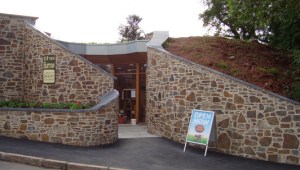
The Burrow in Exbourne is a community-owned shop with a difference – it’s underground. Like something from The Hobbit, this little shop, café and post office is built underneath a field in the centre of the village, and is the UK’s only underground shop.
In December 2001 the village shop and post office in the parish of Exbourne with Jacobstowe in rural West Devon closed and was sold as a private dwelling. This meant that villagers would have to make a journey of at least 5 miles each way to reach the nearest town for shops and services.
Early in 2002 following a public meeting to discuss the closure of the community’s only store and post office, the Exbourne Community Initiative Committee was formed. The original mandate of the organisation was to try and re-establish a shop – a community-run shop – possibly with additional facilities alongside it. The great importance of such activities in safeguarding the quality of village life was keenly recognised and the initiative was supported by the vast majority of local residents.
The Association quickly established a temporary shop, cafe and post office in Exbourne’s Village Hall, opening 2 mornings a week and run (with the exception of the Post Office section) by volunteers.
The shop has grown and grown and with the support of local growers, plus a lot of hard work, they have managed to get together an exciting range of products, from fresh vegetables, canned food and even some hardware items. Each shop day freshly baked bread is locally sourced.
INTERNATIONAL DAY OF HAPPINESS
 A profound shift in attitudes is underway all over the world. People are now recognising that ‘progress’ should be about increasing human happiness and wellbeing, not just growing the economy.
March 20 has been established as the annual International Day of Happiness and all 193 United Nations member states have adopted a resolution calling for happiness to be given greater priority.
In 2011, the UN General Assembly adopted a resolution which recognised happiness as a “fundamental human goal” and called for “a more inclusive, equitable and balanced approach to economic growth that promotes the happiness and well-being of all peoples”.
In 2012 the first ever UN conference on Happiness took place and the UN General Assembly adopted a resolution which decreed that the International Day of Happiness would be observed every year on 20 March. It was celebrated for the first time in 2013.
 In 2017, the Smurfs joined the UN in celebrating the International Day of Happiness as well as the 17 Sustainable Development Goals – #SmallSmurfsBigGoals
The details of 2018 celebrations have not yet been announced, but whatever you have planned for the day, be happy!
How do you Communicate with your Community?
It is only 2 or 3 decades since communication was done by telephone, mail or face to face and all documents were stored in paper or hard copy files. Today the internet and associated devices such as computers, laptops, tablets, mobile devices, etc, are seen as a necessity rather than a luxury.
Since the baseline year of 2007, the percentage of adults using the internet for personal use in Scotland has increased from 62.7% to 83.4% in 2016. The use of the internet (for personal use) is however strongly linked to age. In 2016, 99.1% of 16-24 year olds used the internet for personal use, compared to 71.6% of 60-74 year olds and approximately a third of people aged 75 and older. Adults with a physical or mental health condition lasting or expected to last more than 12 months are less likely to use the internet for personal use. Almost seven out of ten adults with such a longstanding health condition use the internet for personal use, compared to nine out of ten among the rest of the population. (Source: Scottish Household Survey 2017)
 Within the UK of those without internet access, 64% felt they didn’t need the internet as it was regarded as not useful or interesting. A further 20% felt they lacked skills and 12% reported that they had access to the internet elsewhere. (Source:ONS: Internet access – households and individuals: 2017)
There are therefore sections of our population who either do not have or choose not to have digital access. Coupled with the fact that our use of technology is still evolving making it harder for sections of our communities to keep apace with the changes. For example, in social media Facebook, which only emerged 14 years ago is now being abandoned, by young people, for its little sister, Instagram. Reflecting the mobile engagement of the times. Figures from Nielsen Book Research UK survey of 2016 reveal that e-book sales are falling while sales of paper books are growing – and the shift is being driven by younger generations.
The advent of new technologies has changed how we interact, how we communicate and some of our reading habits. Within communities we need to inform and communicate with people both in digital and non-digital formats in order to reach all sectors. What do you find are the best means of communications with your communities? Share your ideas of what works. for you.
 K&M Communities