
Local Blog
Participative Democracy in Practise
Democracy is always in the making: a never-ending project that requires constant rethinking and development.
 Reclaiming and recasting politics and democracy is a core challenge for participatory democrats. The key argument is that citizen participation can reinvigorate democratic life by infusing diversity, experience and knowledge into official decision making. The question is what kind of participation?
In representative democracy, citizens are usually given a thin role in public life, and participation often means casting a ballot every few years, and being occasionally invited to consultations. It seems unsurprising that most citizens don’t grab such opportunities with both hands. Lack of public interest can then be used as an excuse for not supporting citizens to become more involved in governing themselves.
But there are alternative understandings of democracy where participation means direct influence for citizens on the decisions that affect their lives and livelihoods. Why citizen participation? Because our current political systems too often struggle to cope with the pressing issues of our time. We need more problem-solving capacity, better policy and decision making, and new ways of governing. In other words, representative democracy needs a substantial upgrade.
Although there seems to be broad support for democratic principles amongst citizens, there can be mistrust in how current institutions work. Representative democracy can suffer from low turnouts, political disaffection, public cynicism and loss of legitimacy. The answer to the problems of democracy must surely be more democracy, a more meaningful and engaged kind – a participatory democracy, perhaps.
Well-known forms of participation, including volunteering, voting, organising, campaigning and so on, coexist now alongside those that eschew traditional models of organisational affiliation. For instance, many engage passionately on single issues that matter to them, others are political in how they spend their money and time, yet others work to develop new forms of economic life through cooperatives or social enterprises. All forms of participation can contribute to develop a vibrant democracy.
One form of participation being used in Aberdeenshire is participatory budgeting(PB). Following on from PB exercises throughout Aberdeenshire in 2017 and 2018, Peterhead Decides is currently asking the people of Peterhead if they have an idea that would help improve the local environment in Peterhead?
Join us at K and M Communities next week to read more about what Peterhead have been up to!

A Modern Day History Lesson?
 The word ‘idiot’ derives from the ancient Greek for a private citizen who professes no interest in being involved in politics. In the birthplace of democracy, it was simply an article of faith that every citizen would become actively engaged in the political decisions of their towns, cities and nation state. Democracy, as the ancient Greeks conceived it, was a civic duty and any citizen could be called upon to serve. No hustings, no elections, and no political parties. Just the random selection of individual citizens who would willingly step forward when their names were drawn by lot. Known as sortition, this form of democracy would be anathema to our modern-day career politicians. Yet it is a particular form of sortition – the citizens’ assembly – to which many countries around the world are now turning to help resolve some of their most intractable problems. And as we settle down to watch the next instalment of modern-day British democracy of Brexit, many now argue that a randomly selected assembly of citizens, expertly guided and supported, might just offer a sensible way forward. We’d surely be idiots not to try.
Look back next week, to find out a bit more about the participative democracy happening in Aberdeenshire now.
Are you planning to walk further in 2019….?
Hands up if you made a New Year resolution to get fitter, or meet new people in 2019?
Most of us reflect at this time of year and these are certainly achievable and popular resolutions. Walking with friends is an easy and accessible opportunity. Good news is that there is a growing network of walking groups for all abilities across Kincardine and Mearns.
The following are useful organisations and contacts;
1 Paths for All
Paths for All’s vision is for a happier, healthier Scotland where physical activity improves quality of life and wellbeing for all. Read the rest of this entry »
New Website to provide support to anyone affected by alcohol and drugs in Aberdeenshire www.aberdeenshirealcoholdrugs.support

Aberdeenshire Alcohol and Drug Partnership (ADP) have a new website to help support anyone affected by alcohol and drugs in Aberdeenshire. The online resource www.aberdeenshirealcoholdrugs.support aims to provide information and signposting to a range of support services and organisations across Aberdeenshire and nationally.
The website was developed in response to feedback that there was a lack of information in an easily accessible format on what drug and alcohol support was available and how to access help when it was needed. The ADP have worked with service users, family members and people in recovery to make sure that the information on the website is useful, easy to understand and access.
The resource aims to help people using any drug including alcohol, whether worried about their own drug or alcohol use, a friend’s use or family member’s use. www.aberdeenshirealcoholdrugs.support provides a one-stop shop for information on support, treatment and recovery. Within each section, people can find out more about a particular area of support and advice and then clearly see which organisations provide this support and their contact details.
The Aberdeenshire Alcohol Drugs Support website will always have the most up to date information on the Substance Use Service Gateway in Aberdeenshire. . The Gateway is part of the NHS and Council Substance Use Service team and provides confidential, non-judgmental assistance towards the right treatment, support or information. The GET HELP button either the Alcohol or Drugs section of the website displays phone and email details as well as arrangements for drop in facilities around Aberdeenshire.
Professionals and agencies can help any of their clients to engage with the Alcohol or Drug Use Service by calling 01224 558844 or email to nhsg.kessockclinic@nhs.net (North Aberdeenshire) nhsg.grampianscspa@nhs.net (South and Central Aberdeenshire)
Sci-Gateway and Track Care can also still be used for referrals from NHS.
Print materials, posters and cards, promoting the website and access to the Aberdeenshire Alcohol and Drug Service will be delivered to agencies soon. The ADP would be grateful if these could be displayed widely and offered to people who might need help with their alcohol or drug use in Aberdeenshire. To get a supply or resupply contact aberdeenshire.adp@nhs.net
The ADP have identified a wide range of information that they think is useful to people and communities however they welcome approaches from services, groups, community members with information to add or changes to make. Please use the website to share your own news. Send news items and suggested changes to the adp email above. 
Sepa Winter Flood Advice
From December-March, SEPA will be running a reactive communications campaign in response to flooding in Scotland (coastal, river, surface water and snowmelt). SEPA’s Flooding Communications team will monitor the daily Flood Guidance Statements issued by the Scottish Flood Forecasting Service (SFFS), and will seek to activate the campaign when flooding is likely or expected and potential impacts are significant or severe. Upon activating the campaign, key messages will be broadcast on radio and digital channels, and members of the public will be encouraged to visit the Floodline Scotland website where they can sign up to Floodline, SEPA’s public facing flood warning service, and find tips and advice on how to prepare for flooding.
Key Messages
Check your flood risk
– Are you at risk of coastal, river, surface water, snowmelt flooding?
– Does flooding impact you at home, at work, on the road?
Flooding is forecast in your area, plan ahead
– Visit the Floodline website for advice and to register for free flood messages.
– Do you have a plan or flood kit ready?
Floodline can give you advance warning when flooding is expected
– Register online at floodlinescotland.org.uk or by phone on 0345 988 1188.
– You can use your Floodline account to register more than one address, e.g. your property, work or regular travel routes.
How can you get involved?
The aim of the campaign is to provide individuals and communities with advance notice of flooding as well as access to the information they need to be prepared and take action. In order to reach as many members of the public at risk of flooding, we would appreciate your help.
On Twitter and Facebook channels Sepa will share graphics, advice on preparing for flooding, flood alert and flood warning messages. Please retweet or share content on your own social media channels and tag any interested parties who may benefit from this information. For more general awareness raising communications, please feel free to use some of the suggested social media messages below.
Suggested messages for sharing on social media
Dark nights and mornings make it harder to find your way in an emergency. Sign up to Floodline for flood alerts and warnings and keep a torch close by to your bed http://bit.ly/2jPtDrh.
Changed address or phone number? Don’t forget to update your Floodline account with your new
information. Phone Floodline on 0345 988 1188 or update online http://bit.ly/2jMv8qv.
Is your workplace in a flood risk area? Don’t get stranded, plan ahead. Check for alternative routes home and sign up to Floodline for free, advanced flood warning messages sent to your phone
http://bit.ly/2jPtDrh.
Did you know only 15cm of water can knock you off your feet? During a flood, be sure you stay safe and stay away! Visit Floodline Scotland for more advice on how to protect yourself during a flood
http://bit.ly/2mQoGQb.
Are you ready for Scotland’s winter? Be prepared for flooding and sign up to Floodline to receive free flood messages direct to your phone http://bit.ly/2jPtDrh.
Get Ready For Winter
Over the next few weeks, K & M Communities would like to share with you some advice issued by our partners. This week we’re going to start with advice from the Met Office;
Met Office Weather Ready
 The Met Office run an annual public information campaign which is aimed at raising awareness of, and encouraging the public to think about, risks associated with winter weather and the steps they could take to be better prepared.
Since 2011 the ‘Get Ready for Winter’ campaign has been run and implemented by the Met office and Cabinet Office and supported by a range of partner organisations with the same aim – of protecting life and wellbeing, especially during the winter months.
A review held after the 17/18 winter (‘Get Ready for Winter’) campaign indicated the need for some changes to be made, starting with the 18/19 campaign. In brief, the following was agreed upon:
* With snow in March 2018, the name ‘Get Ready for Winter’ felt less appropriate than ever. With this in mind, the name and remit of the campaign will change and will be year-round with a ‘launch’ during the Autumn and increased activity leading up to periods of severe weather.
* Previous campaigns have been purely digital. To reach the vulnerable we need to expand the non-digital content, using partners as the conduit for this information.
Key messages to be shared
* Prepare your property and vehicle ahead of winter, and take responsibility for your own safety.
* Be aware of the latest weather forecasts and warnings from the Met Office and be prepared to alter your plans in times of severe weather. Listen to local radio for updates during times of bad weather.
* Check on the elderly and more vulnerable in your community and check on the safety of your neighbours in the case of an emergency.
Future of our High Streets
Over the past two decades, Britain’s high streets have been in decline as consumer behaviour has changed and economic pressures are causing retailers to close their shops. 
The Centre for Future Studies Innovation Centre, at Kent University, sponsored by Anchor, argues that it is the older generations who will be an economic force to be reckoned with in shaping the reinvention of the high street.
It says that it is those retailers who are able to reinvent their businesses who will survive and prosper. The report estimates that over the next ten years almost two-thirds of all retail spending growth will come from those aged over 55. It says that they are going to drive retail with their considerable purchasing power, shopping behaviour and preferences as retailers respond positively to the demand for elderly friendly shopping environments. Read the rest of this entry »
yang laji, ‘foreign garbage’
China announced in July that from January 2018, it would no longer be accepting imports of 24 grades of solid waste because high levels of contamination were polluting the country’s environment. Furthermore, from March 2018, other imported materials with contamination levels above 0.5 per cent will also be banned. This is a slight relaxation of the 0.3 per cent originally announced, but it remains an extremely challenging goal. The acceptable level was previously set at 1.5 per cent.
The short notice given by China about this change in policy has been criticised as unreasonable by countries that export large quantities of waste. The EU, the USA, Canada, Australia and Korea have all called for a transition period of up to five years to prevent the collapse of the recycling industry.
Exporting recyclable waste to China has historically been extremely cost effective: firstly, because lower quality materials have been accepted; secondly, because there is a ready supply of cheap labour; and thirdly, because materials are shipped on the return journey by vessels carrying goods from China to Europe, which would otherwise be empty on their journey back to Asia. In the case of paper, a lot of this is used to make cardboard boxes for the goods that are subsequently shipped to Europe. This combination of factors has made it more cost effective to export waste to China than to process it in the UK.
The trade in waste plastic has helped fuel China’s manufacturing boom, but also contributed to the increase in UK local authorities accepting plastic for recycling in the early 2000s. However, many UK-based processing companies were driven out of business because of the Chinese market. As a result, there is now very little domestic capacity for recycling.
So, what does this mean for us?
Scotland is taking a strong stance on this, looking at alternatives to exporting our home-grown waste. A return to glass bottle schemes is being considered, along with investment in reprocessing facilities. Beyond this and other measures being considered, there is a need to go to the root of the problem and reduce our use of plastic.
We are at a watershed moment for the UK’s approach to waste. Many have acknowledged that China is quite right to take a firm stance on ‘foreign garbage’. For too long, the UK and other rich nations have allowed the booming Chinese market to mask the real issues around resource use, as well as turning a blind eye to the dumping of low-grade waste. We must start to see our waste as our responsibility, whether that is at a consumer level, a commercial level or in government.
For more information on Aberdeenshire’s approach to recycling visit http://www.aberdeenshire.gov.uk/waste/
To find out more about the impact plastics are having on our marine environment go to https://www.youtube.com/watch?v=uDDFUZRyoIs
The Big Green Footprint Scheme
 Fife Council have come up with an innovative way to invest in their landscape, wildlife, culture and heritage, the Big Green Footprint scheme.
Interested, read on to find out more!
Visitors should be able to enjoy the landscape, wildlife, culture and heritage that Fife has to offer today, without compromising the ability for people to continue to enjoy all that Fife has to offer tomorrow and into the future. Each year Fife draws millions of visitors to the coast and countryside for adventure and quiet enjoyment. However with so many footsteps on paths and wheels on roads some impact on our natural environment is inevitable. It is all about finding a balance between encouraging recreation and tourism to support local livelihoods and protecting and conserving the environment.
The Big Green Footprint scheme is a way of offering visitors the opportunity to give a little something back to the places they love and providing a mechanism for collecting those small contributions which, collectively, add up to a significant amount of funding.
The Big Green Footprint scheme is not a one-size-fits-all type of scheme, but that is one of its great strengths. It is creative, flexible and multifaceted and works in many different ways across a wide range of businesses. Indeed any business which has guests or customers can operate ‘The Big Green Footprint Scheme’.
Businesses can gain Big Green Footprint accreditation in a number of ways, for example, Cafés and Restaurants can name an item on the menu the ‘Coastal Path Loaf or the East Lomond Slice’ and add a small fee to the item to contribute to the work of the Trust in your area, retailers – why not select an item of stock and advertise that part of the proceeds go towards the upkeep of the Coastal Path?
Want to know more, click on the link http://fifecoastandcountrysidetrust.co.uk/Support-Us/Big-Green-Footprint-Scheme_9.html
Fancy a “sidewalk” talk?
 In the Autumn of 2014, two San Francisco therapists shared a vision: to help heal that which divides us through the fine art of skilled listening. They gathered 26 of their colleagues, practiced listening skills and came up with a curriculum and model for listening on the sidewalks together.
On May 7th 2015, for 2 hours in 12 locations throughout San Francisco, listeners set up chairs and signs, offering to listen to any passer-by who wanted to be seen and heard. The result was amazing. And soon after a group from Los Angeles asked if they could reproduce it. There was never an intention for this thing to grow. Every person met at Sidewalk Talk is just like you, someone who believes that human connection is the way to create healthy humans, healthy politics, and a healthy world.
Today Sidewalk Talk has 1700 volunteers world-wide. They have groups in 40 cities around the globe. They have grown but remain grassroots by design. The focus is creating an active, engaged community of volunteers who commit to a regular listening practice and who connect with each other, not just the people they listen to.
Is this a way to gather not only people’s thoughts and opinions, but also raise the important of what the man on the “sidewalk” has to say? Would this work in our communities? Worth a thought!
A Ticking Timebomb?
 China was the Global Nutrition Report’s star performer. It was one of only two countries (the other being South Korea) that posted levels of stunting, women’s anaemia and overweight adults that were all below indications of a very serious public health risk.
China’s numbers are staggering. In the past 10 years GDP per capita has tripled, mortality rates for the under-fives have declined from 37 per 1,000 to 14, and the percentage of the under-fives who are short for their age has declined from 22% to 9%.
But how long will China remain the star performer?
Of great concern in the future are the rapid increases in overweight and obesity in China. While the rates of overweight adults in China are less than half the rates of the UK (and the rates of obesity are about a fifth of the UK’s), the rates for children less than 20 years of age are much closer.
It is this body-mass time bomb that is the most worrying aspect of China’s nutrition status. High body-mass is a risk factor for a range of diseases such as diabetes and some forms of heart disease.
Will we see UK–level rates of obesity in these adults in China in 15 years’ time?
But it is not too late. China has the opportunity and the means to show the rest of the world how to slow and reverse the apparent tsunami of obesity. It has the opportunity because the problem is not yet unmanageable and its economy is strong. This generates policy possibilities. It has the means, because of the strong ability of the state to shape the environment to make healthy choices easier and more likely.
And make no mistake about it – the world needs China to succeed. Obese people tend to consume more of the types of foods that have a higher carbon footprint such as meat, sugar and dairy. There are diets – vegetarian, Mediterranean and pescetarian for example – that are healthier for the planet and for humans. China needs to draw on traditional eating habits and move towards its own 21st century version of a healthier diet – we all have a stake in that.
The 100-Mile Diet.
Following our look at whether local food is “better,” read about a Canadian couple who experimented with this approach….
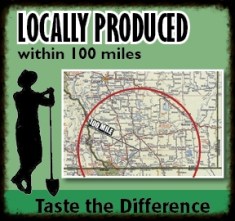 When Alisa Smith and James MacKinnon learned that the average ingredient in a North American meal travels 1,500 miles from farm to plate, they decided to launch a simple experiment to reconnect with the people and places that produced what they ate. For one year, they would only consume food that came from within a 100-mile radius of their Vancouver apartment. The 100-Mile Diet was born.
The concept of the 100-mile diet forces a mental shift from eating globally to think more locally to ensure everything you eat is within a 100 mile radius of your table. Though going cold turkey into eating within such a restricted geographical region may not be for everyone you can start with a single family meal. This forces you to research and explore what’s actually grown close to your home and you’ll begin to appreciate not only the bounty of your local region, but the major implications of eating foods from around the world.
Choosing to consume food that is produced within 100 miles of your home comes with all of the benefits of local, seasonal eating: more flavourful foods, smaller environmental footprint, better health, and support for local farmers.
Alisa and James admit that finding local food sources took a lot of time. Very little in a supermarket can be traced to where all the ingredients come from and many of the products contain oils, sugar or seasonings that have travelled vast distances. So they set about finding just who did produce food in the Vancouver area. Unsurprisingly, one of the biggest challenges was finding carbohydrates during the ‘hungry gap’ before the new season’s harvest began – rice, pasta and bread were all unavailable leaving only potatoes. Between them they lost 15 pounds in six weeks and were forced to loosen the rules slightly to include locally milled flour from grain that at least came from Canada. Summertime made life a little easier, with plentiful Farmer’s Markets a wealth of local foods. This did lead to its own problems though – many hours spent preserving foods for the long Canadian winter.
Is the 100 mile diet one that is realistic for your average person leading a busy life? No, but it was never intended to be. Alisa and James set themselves a high challenge to discover what the real issues with local food sourcing were. In the process they did much more, attracting a world-wide audience and making a bold political statement. This has led some people to label local food as the ‘new organic’ – something that seems to be at odds with the founder’s values which were very much attuned to sustainable organic food production. However, local food sourcing is deservedly gaining attention and the 100 mile diet certainly struck a chord with many who believe in sustainable production.
 K&M Communities