
Local Blog

Period Poverty

Posted on Updated on

Legislation has been officially lodged at the Scottish Parliament to ensure free access to sanitary products for all women. Labour MSP Monica Lennon said her member’s bill aimed to make Scotland a “world leader” in tackling period poverty. It would make it a statutory requirement for schools, colleges and universities to provide such items. The Scottish government has pledged £4m to boost provision in public buildings.

Here in K & M, we were fortunate to have Christine McLean along to a Welfare & Wellbeing Network meeting from CFine to discuss her work on period poverty. In a nutshell, ‘Period poverty’ refers to having a lack of access to sanitary products due to financial constraints. Something that many of us are lucky enough to probably take for granted.

The Scottish Government asked CFINE to operate and coordinate a pilot scheme for six months in 2017-18 through which sanitary products were made available free to all those on low incomes who need them, including any gender categories in need.

Access to Sanitary Products pilot operated in Aberdeen’s regeneration areas through partner organisations.  A wide range of community and voluntary organisations supported the pilot, along with the local authority and educational institutions including; schools, colleges and universities.

Access to Sanitary products cfine

It has ended in a huge success with over 1,000 people signing up to receive sanitary products.  As a result of the success, The Scottish Government has allocated funding to roll-out the distribution of free sanitary products to those in need widely across Scotland, including Aberdeen via the FareShare network.

So, how does this impact in K & M?
What Christine hopes to do is to extend this service into Aberdeenshire. To enable this to happen, a hub for delivery of bulk pallets of the sanitary products needs to be identified which could serve a wider area. For example, in K & M there would be one main hub which would then distribute more widely over the area. Further distribution could be by groups picking up products for a specific settlement and then delivering to all outlets, or encouraging others to collect them. A record is kept of numbers of products distributed to provide tangible evidence of the need for this service and service continuance.

Think you can help out? Get in touch and we will pass on your ideas.

How have you experienced Dementia support across Aberdeenshire?

Posted on Updated on

Have you or someone you know been diagnosed with Dementia? Do you support someone who is currently living with Dementia? If so then we need to hear from you!

The Aberdeenshire Health & Social Care Partnership (AHSCP) is currently in the early stages of developing an Aberdeenshire wide Dementia Strategy and is looking to hear from people affected by Dementia.

To support people with lived experience to tell us about their Dementia journey, we have developed a series of ‘Village Storytelling’ events. Developed in partnership with The Village Storytelling Centre and delivered by colleagues across the health and social care partnership and third sector, sessions will allow those taking part tell their story in a safe and supported environment.

Chair of the Integration Joint Board (IJB) Rhona Atkinson, said, “This strategy will set out how the Partnership supports those living with Dementia and their families over the next 5 years. It is such an important area for us, so it is vital that we understand what support people need, when they need it, what is working well and not so well, now.

“The team working on the strategy have set out a great way to support those who are already living with dementia to participate through the Storytelling sessions and I would urge anyone who is able to come along and join in”

Vice Chair of the IJB, Cllr Anne Stirling, said, “We need to hear from everyone, people with a diagnosis, Unpaid Carers, Volunteers, Third Sector Organisations, family members, professionals; everyone! Whether you do this through the storytelling sessions or through the online survey the team will support you to participate in a way that works for you”


 Public events;

Dementia Storytelling session (Peterhead) – 3rd July 2019, tickets can be booked via – https://www.eventbrite.co.uk/e/dementia-storytelling-session-peterhead-tickets-63109065915

Dementia Storytelling session (Inverurie) – 4th July 2019, – https://www.eventbrite.co.uk/e/dementia-storytelling-session-inverurie-tickets-63107832225

Dementia Storytelling session (Stonehaven) – https://www.eventbrite.co.uk/e/dementia-storytelling-session-stonehaven-tickets-63109373836

In addition to the public events any groups or care settings who would wish to hold their own storytelling session are invited to request one via integration@aberdeenshire.gov.uk

Online survey;

https://aberdeenshirehscp.limequery.org/489997?lang=en

The feedback gathered from the ‘Village Storytelling’ sessions and the survey will be used to develop and inform a draft strategy which will be widely consulted on prior to being finally agreed by the IJB.


Local learning

Posted on Updated on

Good news for those communities with a hankering to visit another community where something of particular interest to them is happening, the Community Learning Exchange is once again open for business. These small awards that pay for travel and subsistence and a host fee, have proved very popular and effective – low on cost, high on impact. What is certainly true is that there is very little that is truly new under the sun and there’s no point in reinventing the wheel. There’s also much to be gained from learning from your peers.

By SCA

The Community Learning Exchange is a fantastic opportunity for communities to learn through the exchange of ideas and the sharing of common solutions.  When community groups make visits to other communities, the most valuable part is often meeting new people with similar interests and gaining new insights and perspectives on shared challenges.  Visiting groups come away armed with new ideas and approaches, and host organisations have the opportunity to explain their project to a new and interested audience, often seeing their own projects afresh through new eyes.

What will the exchange fund?

The Exchange will fund up to 100% of the costs of a visit by members of one community to another community project up to a limit of £750, including a host fee.  In exceptional circumstances (where travel distances are greater or certain aspects of the visit are particularly expensive) this limit can be increased.  Similarly, visits out with Scotland, but within the UK, will be considered where a similar project does not exist in Scotland.

The Exchange will also fund follow up support between organisations.  This might be as a result of a learning visit when it is recognised that more specific and on-going help, support, or advice is required. This can be through face-to-face meetings, by phone, e-mail, or skype. Funding for this kind of additional support will need to be negotiated separately.

How to apply

The Exchange operates primarily through the networks that comprise the Scottish Community Alliance.  The exception to this rule are Scotland’s community councils. Since the demise of the Association of Scottish Community Councils, there has been no umbrella body for community councils.

Applications to the Exchange are processed through one or other of the networks’ designated members of staff. The exception to this rule are community councils who should apply directly to the Exchange Coordinators.  Applications can be made at any time for visits throughout 2019 and up until March 2020. Funding is limited, and once it has been committed no further applications will be accepted.

For guidance about the Community Learning Exchange click here and an application form click here.

Please remember, applications must be endorsed by a network that is a member of SCA unless your organisation is a community council.

Community Heritage

Posted on Updated on

Twelve discussion days are being held around Scotland in 2019 for people who are involved with heritage in their communities in any way. You might be a volunteer, someone managing a heritage site, or perhaps running a business – or just interested and actively involved.

Scottish Community Alliance will be talking about a potential new national network for community heritage. How might it work, and how might it meet your needs and wants?

What you tell them will directly influence what happens in the future, so come and join in the conversation.

The workshops are free to attend, and there will be plenty of tea and biscuits – but please bring your own lunch! Not providing lunch has enabled SCA to reach more communities.

All events start at 10.30am and finish at 4pm *except for Leverburgh which is an hour later to fit ferry times.

The research workshop tour is organised by the University of St Andrews together with the National Library of Scotland and Ergadia Museums and Heritage, and working closing with the grass-roots led Scottish Community Heritage Alliance.

The project is funded by the Royal Society of Edinburgh.

Click here for tickets to all future events.

Strathpeffer Community Centre, Strathpeffer – 31st May

Timespan, Helmsdale – 4th June

Garioch Heritage Centre, inverurie – 7th June

Blairgowrie Town Hall, Blairgowrie – 8th June

Voe Hall, Shetland – 29th June

Kyle Village Hall, Kyle of Lochalsh – 18th September

Nevis Centre, Fort William – 19th September

Kilmartin Church, Kilmartin – 20th September

Eyemouth Hippodrome, Eyemouth – 11th October

Leverburgh Hall, Isle of Harris – 25th October * starts 11.30am, ends 5pm


Volunteers of the future

Posted on Updated on

People volunteer for all manner of reasons and roughly half of the population do so at some point in their lives. While that might seem like a lot of people, equally it means there’s a lot of people choosing not to participate. Dig a little deeper into the numbers and it becomes apparent that around a fifth of those who volunteer do two thirds of all the volunteering work. Dig some more and you hit the problem of an aging population with its potential impact on volunteer numbers going forward.

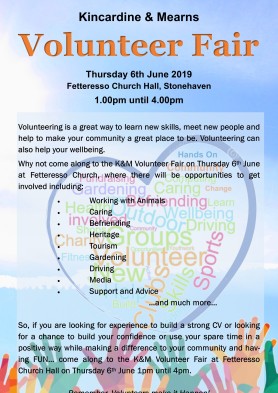
On a local level, Stonehaven Learning partnership is hosting a volunteer event on 6th June. See picture for more details.


Volunteering For All

Volunteering in Scotland is already making a crucial contribution to building social capital, fostering trust, binding people together and making our communities better places to live and to work.

Action to increase volunteering participation for all and to address inequalities is vital to continue to expand opportunities for more people to volunteer and participate in society. Although an estimated 51% of the adult population in Scotland has volunteered at some point in their lives, 49% have not. An increase in volunteering will also make a considerable contribution towards our individual, community and national economic and social well-being, particularly in the face of demographic and societal change.

The annual value of volunteering in Scotland is estimated to be £2.26 billion.4 Volunteering is clearly of great social and economic importance to the people and communities of Scotland. Within these communities, there are often those who are more likely, or more able, to volunteer than others. Volunteers in Scotland are more likely to be:

  • female
  • self-employed/part-time employed or in education
  • from higher socio-economic and income groups
  • from rural areas
  • from less deprived areas
  • healthy and non-disabled

Read the rest of this entry »

Bettridge Survey

Posted on Updated on

As most of you will know, the Bettridge Centre is an important local community-owned and managed facility which offers a wide selection of activities for the whole ​community and for visitors.   Some public consultation has already taken place and the centre has commissioned Community Enterprise to build on that positive momentum with more detailed local research.  The core aim is to find out what is needed in the community and use that to set out a plan to upgrade the building to meet the needs of Newtonhill and the surrounding area.

Want to make your voice heard, take part in the survey, link below;

https://www.surveymonkey.com/r/Bettridge

The power of the volunteer

Posted on

The BBC documentary The Great Storm That Saved a City provides fascinating insights not only into the storm itself but how it played its part in transforming Glasgow’s housing and in particular how it sowed the seeds of the city’s community controlled housing associations. These tenant-led organisations have consistently argued for their governance to be an unpaid, voluntary affair. While there is an argument from some quarters to have paid board members, this has been strongly resisted in the community-controlled sector. 

Scotland’s housing association sector has always been a diverse one, and time will tell whether it ever becomes more than a handful which pay some of their board members. The long-standing commitment to the principles and practice of voluntarism is the DNA of the community controlled housing association (CCHA) sector but goes well beyond that part of the movement and, critically, doesn’t in any way signify a reluctance or inability to modernise.

The CCHA sector has  been well served by a governance model based entirely on the input of volunteers. But sticking to that model doesn’t mean that they’re standing still in the challenging financial and regulatory environment we all face.

Quietly and organically, CCHAs have been looking at the mix of experience and skills they need to ensure a healthy board/management committee into the future. Some have chosen to advertise, and this has often led to them being able to bolster both the number of board members (some local, some not) and the range of skills and experience available to the association. Read the rest of this entry »

Bottled gold – the unexpected side effects of recycling in Germany

Posted on Updated on

A German recycling scheme is proving to be a source of relief for those on low-incomes, but is it also having an impact on recycling levels as a whole?

For pensioners and the unemployed in Berlin, summer marks a particularly welcome time of the year for making a spot of extra cash. As Berliners head to the park to enjoy sunshine, barbecues and a casual drink with friends and family, the hunt for empty leftover bottles begins.

Introduced in 2003 by the then Social Democrat/Green coalition government, the ‘bottle recycling deposit return scheme’, known as the Deutsche Pfandsystem (or ‘Pfand’ for short) in Germany, requires large drink retailers to charge an additional €0.08 to €0.25 for every drink purchased at a store depending on the material of the bottle. The consumer can then redeem that money by bringing their emptied bottles back to the shop and recycling them instead of simply throwing them away.

The rationale behind the scheme is both to reduce waste and encourage recycling of single-use products, as well as to develop an environmental consciousness among the German population. In a world where more than 100 million plastic bottles are used everyday worldwide, and with only one out of five being recycled (the rest becoming litter buried underground or ending up in our ocean’s waters), mindfulness about current global consumption patterns is a vital step towards a sustainable future.

Thanks to Pfand, over 97 per cent of plastic and glass bottles are now recycled in Germany. At first sight, the scheme appears to be a resonating success. However, the motivation behind the bottle collection scheme has increasingly become driven by economic and social factors rather than genuine environmental concerns. As such, Pfand is bringing to light the challenges faced by the least privileged part of the German population every day.

When Pfand started operating in 2003, it was mainly homeless people, alcoholics and drug addicts that would rummage the bins in the search of this ‘bottled gold’. However, by 2005, unemployment rates had soared to 13 per cent and an estimated one out of every seven Berliners was said to be living on the verge of poverty. Since then, an increasing number of jobless people and pensioners have been spotted engaging in bottle-collecting activities in the hope of making ends meet. Sabine Werth, head of Berliner Tafel, a non-profit organisation that distributes food donations to local charities comments: ‘The number of unemployed collectors has probably doubled in the past few years. This is a symptom of an inadequate social system struggling to cope with a rising number of elderly people and unemployed.’ Recycling plastic bottles is being seen as a way to provide a cash boost to those with under-performing pensions.

Bottle recycling is being seen by Berlin’s unemployed as a cash resource (Image: Barbara Wheeler)Bottle recycling is being seen by Berlin’s unemployed as a cash resource (Image: Barbara Wheeler/Shutterstock)

However, fighting poverty does not seem to be the only reason bottle-collecting has become increasingly popular. ‘For the older generation it provides a sense of purpose,’ says Werth. ‘They see it as a reason to get out of the house and come into contact with people.’ Günther, a former mechanic who had to retire early due to illness, adds that this new-found activity helps him fight loneliness as people on the street often strike up conversation with each other. ‘I get to meet all sorts of people, which can be fun,’ he says. ‘I had a job in a museum for a while, but I nearly died of loneliness in that place.’

Many Berliners are supporting the practice. Residents and party-goers often leave empty bottles in lines along the pavements or in a pile next to bins, allowing collectors to seize the coveted goods without having to rummage through waste. Communication design student Jonas Kakoschke took things one step further. In July 2011 he set up the website Pfandgeben.de. Two types of people can sign up to this online platform: collectors and disposers. The site allows residents who have bottles they wish to dispose of to find details of local collectors in their area and to contact them to arrange for a pick-up. The initiative became so popular it ended up expanding to Cologne, Augsburg and Essen. However, Werth admits that this new system only targets those who already have certain means (such as a mobile phone), leaving the most marginalised and destitute once more on the sideline.

Bottles piled by rubbish binBottles piled by rubbish bin for collectors to easily gather (Image: Jacky D/Shutterstock)

This increase in collection numbers is turning bottle recycling into a competitive business. Nowadays, collectors are not only having to fight for resources among each other, but are also needing to stand up to government and industrial backlash. In Stuttgart, the city council introduced bins that keep waste underground, allegedly to increase storage capacity, but social workers have been accusing the authorities of implementing defensive architecture in order to to push certain parts of the population out of the city centre.

Another downside of the German bottle scheme according to environmental pressure groups is that it reduces the incentive to introduce genuinely green reusable drink containers to the market by framing the recycling of single-use bottles as a sustainable alternative. Finally, because discount giants such as Aldi or Lidl need to keep prices low to stay competitive, they have been reintroducing non recyclable bottles to their shelves in order to avoid charging their customers the extra green deposit. Consequently, it is estimated that the number of recyclable bottles on the German market has dropped from 80 per cent to 50 per cent since 2003.

 

Read the rest of this entry »

DON’T MISS YOUR CHANCE TO HAVE YOUR SAY!

Posted on

Grampian System Wide Mental Health and Learning Disability Services Review

I would like to invite you to participate in the Grampian Mental Health and Learning Disability Service Review. NHS Grampian, together with Aberdeen City, Aberdeenshire and Moray Health & Social Care Partnerships (HSCPs) are reviewing the sustainability of the provision of local and Grampian wide Mental Health and Learning Disability (MHLD) services, building on local engagement in a number of areas. This includes services for children and adolescents (CAMHS), adults and older people spanning self-management, GP and primary care services, community services and specialist inpatient care.

The Health and Social Care Alliance Scotland (the ALLIANCE) has been asked to help support the review by facilitating a series of consultation events across Grampian throughout April/May 2019 where you will be given the opportunity to hear from NHS Grampian planners and give your views on what’s working, what could be improved and where there are service gaps.

There will be events taking place at various times and in different locations below. To reserve your place at an event, please follow the Eventbrite link and book the session that’s best for you.

  • Aberdeen City on Monday 29 April 2019 – Jurys Inn, Union Square AB11 5RG – 12.00 pm to 2.30 pm BOOK NOW
  • Aberdeen City on Monday 29 April 2019 – Jurys Inn, Union Square AB11 5RG – 5.30 pm to 7.30 pm BOOK NOW
  • Inverurie on Tuesday 30 April 2019 – Fly Cup, Blackhall Industrial Estate AB51 4FS – 12.00 pm to 2.30 pm BOOK NOW
  • Fraserburgh on Tuesday 30 April 2019 – Fraserburgh Community and Sports Centre, Maconochie Place AB43 9TH – 1 pm to 3.30 pm BOOK NOW
  • Stonehaven on Tuesday 30 April 2019 – Stonehaven Community Centre, Bath Street, Stonehaven, AB39 2DH 6.00 pm to 8.00 pm BOOK NOW
  • Elgin on Wednesday 1 May 2019 – The Mansfield Hotel, 2 Mayne Road IV30 1NY – 12.00 pm to 2.30 pm BOOK NOW


We want to ensure we capture the views of as many people as possible, therefore we would be delighted for you to share this invitation amongst your own contacts and networks as the events are open to all.

In addition, the ALLIANCE can provide a facilitation pack if you would like to host your own event to capture views. For any questions or queries please get in touch by emailing comms.coordinator@alliance-scotland.org.uk or phoning Gerry Power, Director at the ALLIANCE on 0141 404 0231.

Snow Warden Scheme

Posted on Updated on

Scores of volunteers have signed up to help ensure Aberdeenshire’s roads and pavements are safe as the wintry weather continues.

The authority is regularly criticised during spells of severe weather for failing to clear side roads and paths.

However priority is given to maintain main roads and resources are stretched to grit and clear every single area.

In an effort to ease frustration and deal with the problem, Aberdeenshire Council launched a snow warden scheme which gives communities access to a range of resources from grit spreaders to full protective equipment.

As of this month, there are now 27 groups operating in the region, which amounts to 72 volunteers.

But the authority has issued a fresh appeal for more wardens, with the scheme running until April.

Applications are taken throughout the year for the initiative.

Last year, the region endured one of the worst winters in recent memory, with the council forced to go £2million over budget to treat the roads and pavements.

Roads bosses came under fire after towns and villages were left impassable after the traditional surface treatment was left redundant by thawing conditions, rainfall and freezing temperatures overnight.

This year the authority has already used about 23,300 tonnes of salt to treat surfaces since October, with a further 15,000 tonnes in stock and more than 7,000 expected to be delivered this month.

The council has also been trialling a new app which shows people where gritters are in real time and what routes have been dealt with.

The programme is currently only available on phones and tablets as My Aberdeenshire, but is likely to be made available on their website in the future.

There are 32 “primary routes” with 100 council drivers covering these, there have also been 120 farmers and 32 plough contractors on the roads to clear the snow in recent weeks.

For more information on the snow warden scheme visit www.aberdeenshire.gov.uk


By Press and Journal

£700,000+ to increase community resilience in flood protection

Posted on

Communities across Scotland will benefit from £713,000 in additional funding to improve flood protection. (Source: ScotGov)

This includes:

  • £300,000 to support the Scottish Environment Protection Agency (SEPA)
  • £180,000 to gather Light Detection and Ranging (LiDAR) data which surveys terrain
  • £33,000 in 2019/20 for the ‘Scottish Flood Forum’ to raise awareness of the importance of making flood resilient repairs and installing flood protection measures for property

Peterhead Decides

Posted on Updated on

Peterhead is asking the question of its communities, do you have an idea that would help improve the local environment in Peterhead?

If the answer is yes, then Peterhead Decides Community Choices is an opportunity to
make the idea happen. £20,000 is available to allow residents to decide what landscape or road
maintenance improvements they would like to see in the Peterhead area.

Community Choices is about local people coming together to decide how public money
should be spent in their communities, but basically it looks like this:
1. Ideas are generated about how money should be spent
2. Local people decide on their priorities
3. The ideas with the most support are implemented


Any local community, voluntary, or non–profit organisation, even informal groups or any local resident
who has an idea and is interested in improving the local environment in Peterhead can submit an idea. Projects will then  be assessed for feasibility and cost and then the local community will be asked to decide which projects they think will make the biggest improvements and should be implemented in 2019.

So what makes for a good idea?
Ideas can be large or small, whether you want to improve the physical appearance to promote a positive image of the town through increasing the amount of summer bedding plants distributed for planting, improve local paths to make the area more accessible or improve the landscape to help cleanliness.
However, ideas for projects must improve the physical environment of Peterhead, cost under £20,000,
benefit as many people as possible and be delivered by the end of 2019.

Projects like Peterhead Decides are a great opportunity for communities to become involved in their local democracy, and influence decisions that matter to them.