
community
Get Ready For Winter
Over the next few weeks, K & M Communities would like to share with you some advice issued by our partners. This week we’re going to start with advice from the Met Office;
Met Office Weather Ready
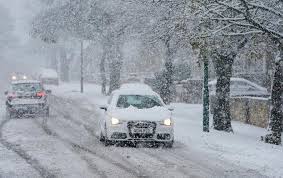 The Met Office run an annual public information campaign which is aimed at raising awareness of, and encouraging the public to think about, risks associated with winter weather and the steps they could take to be better prepared.
Since 2011 the ‘Get Ready for Winter’ campaign has been run and implemented by the Met office and Cabinet Office and supported by a range of partner organisations with the same aim – of protecting life and wellbeing, especially during the winter months.
A review held after the 17/18 winter (‘Get Ready for Winter’) campaign indicated the need for some changes to be made, starting with the 18/19 campaign. In brief, the following was agreed upon:
* With snow in March 2018, the name ‘Get Ready for Winter’ felt less appropriate than ever. With this in mind, the name and remit of the campaign will change and will be year-round with a ‘launch’ during the Autumn and increased activity leading up to periods of severe weather.
* Previous campaigns have been purely digital. To reach the vulnerable we need to expand the non-digital content, using partners as the conduit for this information.
Key messages to be shared
* Prepare your property and vehicle ahead of winter, and take responsibility for your own safety.
* Be aware of the latest weather forecasts and warnings from the Met Office and be prepared to alter your plans in times of severe weather. Listen to local radio for updates during times of bad weather.
* Check on the elderly and more vulnerable in your community and check on the safety of your neighbours in the case of an emergency.
Future of our High Streets
Over the past two decades, Britain’s high streets have been in decline as consumer behaviour has changed and economic pressures are causing retailers to close their shops. 
The Centre for Future Studies Innovation Centre, at Kent University, sponsored by Anchor, argues that it is the older generations who will be an economic force to be reckoned with in shaping the reinvention of the high street.
It says that it is those retailers who are able to reinvent their businesses who will survive and prosper. The report estimates that over the next ten years almost two-thirds of all retail spending growth will come from those aged over 55. It says that they are going to drive retail with their considerable purchasing power, shopping behaviour and preferences as retailers respond positively to the demand for elderly friendly shopping environments. Read the rest of this entry »
yang laji, ‘foreign garbage’
China announced in July that from January 2018, it would no longer be accepting imports of 24 grades of solid waste because high levels of contamination were polluting the country’s environment. Furthermore, from March 2018, other imported materials with contamination levels above 0.5 per cent will also be banned. This is a slight relaxation of the 0.3 per cent originally announced, but it remains an extremely challenging goal. The acceptable level was previously set at 1.5 per cent.
The short notice given by China about this change in policy has been criticised as unreasonable by countries that export large quantities of waste. The EU, the USA, Canada, Australia and Korea have all called for a transition period of up to five years to prevent the collapse of the recycling industry.
Exporting recyclable waste to China has historically been extremely cost effective: firstly, because lower quality materials have been accepted; secondly, because there is a ready supply of cheap labour; and thirdly, because materials are shipped on the return journey by vessels carrying goods from China to Europe, which would otherwise be empty on their journey back to Asia. In the case of paper, a lot of this is used to make cardboard boxes for the goods that are subsequently shipped to Europe. This combination of factors has made it more cost effective to export waste to China than to process it in the UK.
The trade in waste plastic has helped fuel China’s manufacturing boom, but also contributed to the increase in UK local authorities accepting plastic for recycling in the early 2000s. However, many UK-based processing companies were driven out of business because of the Chinese market. As a result, there is now very little domestic capacity for recycling.
So, what does this mean for us?
Scotland is taking a strong stance on this, looking at alternatives to exporting our home-grown waste. A return to glass bottle schemes is being considered, along with investment in reprocessing facilities. Beyond this and other measures being considered, there is a need to go to the root of the problem and reduce our use of plastic.
We are at a watershed moment for the UK’s approach to waste. Many have acknowledged that China is quite right to take a firm stance on ‘foreign garbage’. For too long, the UK and other rich nations have allowed the booming Chinese market to mask the real issues around resource use, as well as turning a blind eye to the dumping of low-grade waste. We must start to see our waste as our responsibility, whether that is at a consumer level, a commercial level or in government.
For more information on Aberdeenshire’s approach to recycling visit http://www.aberdeenshire.gov.uk/waste/
To find out more about the impact plastics are having on our marine environment go to https://www.youtube.com/watch?v=uDDFUZRyoIs
Stuck for what to do in the holidays? Check out Scottish Natural Heritage explore for a day for some great ideas.
 Renowned for its rich cultural heritage and abundant wildlife, Aberdeenshire has something for everyone. This leaflet includes four possible itineraries for a day out in this breathtaking north-eastern region of Scotland.
Stroll along stunning stretches of sandy beaches, hike through wild landscapes or ramble atop dramatic cliffs. Aberdeenshire’s various nature reserves also offer unrivalled opportunities to spot a wealth of wildlife. Head to the region’s coastline to spot waders, seals and falcons, and glimpse red squirrels and the Scottish crossbill above your head in majestic ancient woodlands.
Or how about a spot of time travel? Dating back thousands of years, the region boasts an impressive 99 standing stone sites. Or take a tour through Scottish history via Aberdeenshire’s many castles and strongholds perched atop rugged cliffs, set in wide expanses of moorland and nestling within beautiful landscaped gardens.
All this and more awaits you here in Aberdeenshire. What are you waiting for?
Carers Week 11th – 17th June 2018
 Carers Week is an annual campaign to raise awareness of caring, highlight the challenges carers face and recognise the contribution they make to families and communities throughout the UK.
Quarriers – Aberdeenshire Carer Support Service are hosting a series of promotional events during Carers Week, in partnership with Aberdeenshire Library and Information Service (ALIS). Libraries will display the winning entries from the recent adult carer poetry and photography competitions and Quarriers staff will be going on tour with the central and south mobile library buses to reach out to hidden carers in rural areas. A presentation booklet of the winning entries and details on where unpaid carers can get support will be available for the public to take away. If you would like to find out the routes on their tour please visit:
Mobile Library Central – www.aberdeenshire.gov.uk/media/22122/m1-central-mar-jun-2018.pdf
Mobile Library South – www.aberdeenshire.gov.uk/media/22123/m4-south-mar-jun-2018.pdf
Thank you for your support to end child poverty
 If you haven’t already seen them, have a look at these animations. Talented students from the London College of Communication interpreted children’s experiences of poverty and made some very powerful short films. They show clearly why we’re needed, and why your support is so important.
Child Poverty Action Group
Using Schools as Community Hubs
Schools across Scotland should be used as community hubs to deliver a wide range of public services.
That’s the verdict of South Ayrshire Council and its partners following a pilot in north Ayr, which culminated in a community marketplace at Ayr Academy on 23 February.
A range of partners from NHS, Scottish Fire and Rescue service and the voluntary sector worked together to explore how this would work in practice.
Crucially, services were available to everyone living in the area – not just those with children in the schools.
Services provided included money and debt management advice, employability and skills information and advice, health and wellbeing support from school nurses and assistant nurse practitioners. Council Leader, Douglas Campbell, commented on the learning from the pilot,
“It’s been a terrific learning opportunity for all the partners involved and that’s been one of the key outcomes of this week – getting to know more about what each of us has to offer and how we can better link in and signpost to provide a more joined-up service for people.”
Read more at http://thirdforcenews.org.uk/tfn-news/schools-should-be-used-as-community-hubs#im6LrHufaQ4Ga4ce.99
Spare Chair Sunday
 Spare Chair Sunday first launched in 2015 as a partnership between national charity Contact the Elderly and Bisto. Expanding on the charity’s model of free monthly Sunday afternoon tea parties for small groups of older people aged over 75 who live alone, Spare Chair Sunday encouraged people to offer a ‘spare chair’ at their Sunday lunch tables to a Contact the Elderly older guest and their volunteer driver, to share a delicious warm lunch all together. The response to the award-winning campaign was amazing, with over 1,600 Spare Chair Sunday volunteers hosting Sunday lunches or becoming regular tea party volunteers in their local community.
Any host homes or venues must have a downstairs toilet and be easily accessible (generally we say no more than three steps where possible).
Any car used must be fully insured and drivers must hold a full driving licence, as well as supplying two references and completing a DBS check. This is for the safety and security of guests and host.
Interested? Click on http://www.contact-the-elderly.org.uk/volunteer to apply to become a volunteer. Applications are dealt with as soon as possible, but please do be patient, all necessary checks must be made. In some cases, there will not be anyone near enough to you, groups may already have as many volunteers as they require, or there may not be a group in your area. It may be the case that your application may enable work to be launched in the area for the first time, enabling more older people to benefit!
Fancy a Trip Underground?
Some beautiful and unusual buildings and land are in community ownership.
A growing number of groups are getting together to rescue much-loved places from redevelopment or demolition – from castles and piers to public toilets.
Could your community take ownership of a local space? To inspire you, over the next few weeks we would like to share with you some of these. First up, The Burrow, Devon. 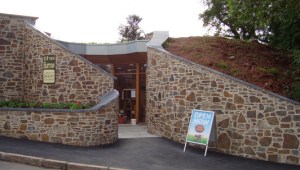
The Burrow in Exbourne is a community-owned shop with a difference – it’s underground. Like something from The Hobbit, this little shop, café and post office is built underneath a field in the centre of the village, and is the UK’s only underground shop.
In December 2001 the village shop and post office in the parish of Exbourne with Jacobstowe in rural West Devon closed and was sold as a private dwelling. This meant that villagers would have to make a journey of at least 5 miles each way to reach the nearest town for shops and services.
Early in 2002 following a public meeting to discuss the closure of the community’s only store and post office, the Exbourne Community Initiative Committee was formed. The original mandate of the organisation was to try and re-establish a shop – a community-run shop – possibly with additional facilities alongside it. The great importance of such activities in safeguarding the quality of village life was keenly recognised and the initiative was supported by the vast majority of local residents.
The Association quickly established a temporary shop, cafe and post office in Exbourne’s Village Hall, opening 2 mornings a week and run (with the exception of the Post Office section) by volunteers.
The shop has grown and grown and with the support of local growers, plus a lot of hard work, they have managed to get together an exciting range of products, from fresh vegetables, canned food and even some hardware items. Each shop day freshly baked bread is locally sourced.
A Cupful of Sugar
Borrowing from neighbours was once a commonplace practice, part of the network of relations we once had with those who lived within close range. 
So what’s changed?
The industrial revolution brought affordable modern technology—with it quick transportation and supermarkets. In ancient times, hunting, gathering, and foraging were communal practices. And it wasn’t long ago that many cultures, especially rural ones, still relied on weekly markets, traveling salesmen, and the growing of their own goods. But living in relative isolation also meant more contact with your neighbours because one of them probably provided your weekly dairy needs and another milled wheat for flour or grew pears you exchanged for apples.
Changes in food technology, making fresh produce less perishable, extending shelf life, has decreased the interaction we have with those who live close by to help out when we are running short. Communal cooking practises regularly seen in other countries don’t feature in our society.
It’s easy to reflect on past practises with rose tinted spectacles. Changes in our food supply has brought countless benefits. However, does the growing reliance on foodbanks indicate we should re-evaluate practises long forgotten? Reconnecting with our neighbours in times of need would not only strengthen bonds within our communities but provide welcome support during difficult times. The social distance created by modern society is a symptom of our increasingly busy lives and the sprawling communities we now live in. However, it is only a short walk next door for that cupful of sugar, but the benefits to our communities can stretch much further than that.
Community Cohesion – Do ants hold the secret to human success?
 Solomon thought so, he says to ‘go to the ant’ and ‘consider the ant’ and refers to them as little upon the earth but exceeding wise. He suggests that taking a leaf from their book will preserve us from poverty and give us wisdom. Given Solomon is the richest man the world has ever known (today he would be worth 100 times more than John D Rockefeller), some ant facts are worth knowing.
So, how do ant communities do it?
1. Strong leadership
Ant communities are headed by a queen or queens, whose function in life is to lay thousands of eggs that will ensure the survival of the colony. Workers (the ants typically seen by humans) are wingless females that never reproduce, but instead, forage for food, care for the queen’s offspring, work on the nest, protect the community, and perform many other duties. When the queen of the colony dies, the colony can only survive a few months. Queens are rarely replaced and the workers are not able to reproduce. The lesson;
Without strong and clear leadership – failure is imminent!
2. Communicate & cooperate
Ants are social insects which form colonies that range in size from a few dozen predatory individuals living in small natural cavities to highly organised colonies which may occupy large territories and consist of millions of individuals. Ants communicate and cooperate by using chemicals (pheromones) that can alert others to danger or lead them to a promising food source. The lesson;
Nothing can succeed without clear communication and cooperation.
Kindness within a Community: Combating loneliness and building stronger communities
 Carnegie Trust UK have published their second report looking at loneliness and social isolation and the impact of kinder communities. The report finds kindness is a necessary ingredient of successful communities. However there are major factors that get in the way of engaging and encouraging kindness both in individuals and organisations. Read the report here
 K&M Communities