
 Across The Grain is running for the second time throughout October, with an exciting and eclectic mix of activities, performances and workshops for all ages.
Had you been taking a stroll around downtown San Francisco in late September 2005 you might have noticed something unusual – an ordinary parking space turned into a tiny park featuring a tree, a patch of grass and a bench. This miniature patch of greenery was the brainchild of three urban designers and led to an unexpected global movement known as PARK(ing) Day. Held on the third Friday of September every year, PARK(ing) Day has seen thousands of otherwise grey spaces temporarily transformed, from a spot on London’s South Bank to a sidewalk in Alaska.
The PARK(ing) Day movement captured imaginations, but it’s not the only one of its kind. Pop-up parks (PUPs) are a growing phenomenon, one that a group of urban researchers from the Royal Melbourne Institute of Technology is taking seriously. They argue that PUPs (which they define simply as ‘temporary green spaces’) have the capacity to benefit both biodiversity and the people who live in cities. The group cites several studies that have demonstrated the importance of nature for human wellbeing, including a paper in the Annual of Public Health which concluded that: ‘Taken together, the research reviewed does indicate that contact with nature can promote health. The evidence for some benefits, such as short-term restorative effects, is already quite strong.’
 A’Beckett Urban Square PUP on the City Campus of RMIT University in Melbourne [Image: J Gollings]
‘There’s a lot of underutilised space in cities, and it’s going to be increasingly key to bring nature back into cities and have it close to offices,’ says Luis Mata, lead author of the study. ‘Some PUPs might only last for a couple of hours, whereas others last for years and may even become a path to something permanent. Depending on their deign and their spatial and temporal scales some will provide more benefits for people, some for biodiversity and some for both.’
The study points to a number of PUPs already in motion. In particular, San Francisco’s ‘Pavement to Parks’ program – an initiative that seeks to transform underutilised street spaces into public plazas known as ‘parklets’. It also refers to the UK’s Design Council and its ‘Knee High Design Challenge’ funding scheme which saw a PUP project trialled in Lambeth and Southwark. The transformed spaces were designed to encourage play and were filled with games for young children.
 “Grasslands” PUP at the State Library of Victoria in Melbourne [Image: M Stanton]
To address the lack of research into such spaces, the researchers want to see future sites become ‘socioecological laboratories’ in which urban planners conduct experiments to inform future design. Leading the way, Mata and his colleagues carried out their own analysis on a PUP in their home-town of Melbourne. They found that the six-week project called ‘Grasslands’, installed at the State Library of Victoria, saw insect pollinator abundance increase by around 160 per cent while the PUP was present.
The human impact of these spaces is harder to evaluate precisely. Nevertheless, the researchers contend that in dense urban environments with plenty of small, underutilised spaces, PUPs can help people spend time in nature, as well as foster community and in particular, creativity. ‘Creative thinking is sometimes lacking in academia,’ says Mata. ‘This new movement of people with artistic minds thinking of putting nature into cities is really excellent and is something that PUPs are uniquely placed to take advantage of.’

 This report presents some initial findings about the lives of 12-year-old children living in Scotland. It uses data collected from Birth Cohort 1 (BC1) of the Growing Up in Scotland study (GUS). GUS is an important longitudinal research project aimed at tracking the lives of Scottish children from birth, through their childhood, into adolescence and beyond. The study is funded by the Scottish Government and carried out by ScotCen Social Research.
 Preserving dignity looks like it is being built into the design Scotland’s new social security system. It’s also the phrase that was at the heart of work undertaken by the Poverty Truth Commission and Nourish Scotland on the
 Good news for those communities with a hankering to visit another community where something of particular interest to them is happening, the Community Learning Exchange is once again open for business. These small awards that pay for travel and subsistence and a host fee, have proved very popular and effective – low on cost, high on impact. What is certainly true is that there is very little that is truly new under the sun and there’s no point in reinventing the wheel. There’s also much to be gained from learning from your peers.
 Twelve discussion days are being held around Scotland in 2019 for people who are involved with heritage in their communities in any way. You might be a volunteer, someone managing a heritage site, or perhaps running a business – or just interested and actively involved.
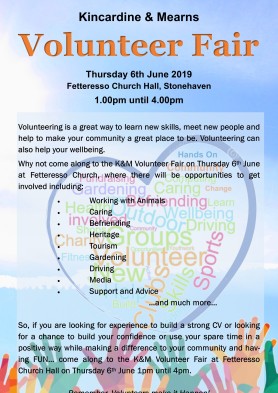 People volunteer for all manner of reasons and roughly half of the population do so at some point in their lives. While that might seem like a lot of people, equally it means there’s a lot of people choosing not to participate. Dig a little deeper into the numbers and it becomes apparent that around a fifth of those who volunteer do two thirds of all the volunteering work. Dig some more and you hit the problem of an aging population with its potential impact on volunteer numbers going forward.
 As most of you will know, the Bettridge Centre is an important local community-owned and managed facility which offers a wide selection of activities for the whole community and for visitors. Some public consultation has already taken place and the centre has commissioned Community Enterprise to build on that positive momentum with more detailed local research. The core aim is to find out what is needed in the community and use that to set out a plan to upgrade the building to meet the needs of Newtonhill and the surrounding area.
 Scores of volunteers have signed up to help ensure Aberdeenshire’s roads and pavements are safe as the wintry weather continues.
 Community Choices is about local people coming together to decide how public money
 Reclaiming and recasting politics and democracy is a core challenge for participatory democrats. The key argument is that citizen participation can reinvigorate democratic life by infusing diversity, experience and knowledge into official decision making. The question is what kind of participation?
 K&M Communities